## Acknowledgement of country I would like to start by acknowledging that we are on the traditional lands of the Pambalong clan of the Awabakal nation. I acknowledge and pay my respect to the Elders past, present and emerging. I would like to extend this acknowledgement and pay my respects to Aboriginal and/or Torres Strait Islander peoples here today. I recognise that First Nations sovereignty was never ceded. This continent always was and always will be Aboriginal Land. --- ## Welcome to MATH2340: Linearity & Continuity #### Linearity Solving systems of linear equations, Data compression, Computer graphics, Machine learning / AI #### Continuity Calculus done rigourously, Differential equations, Scientific laws & engineering principles --- ## What else will I learn? * Abstraction * Mathematical argument & writing --- ## How will I learn? * <span class="fragment daz-switch preload" data-fragment-index="0">R</span><span class="fragment daz-switch" data-fragment-index="1">Actively r</span><span>eading lecture notes</span> * <span class="fragment daz-switch preload" data-fragment-index="0">Attempting</span><span class="fragment daz-switch" data-fragment-index="1">Completing</span><span> Canvas quizzes</span> * <span class="fragment daz-switch preload" data-fragment-index="0">Watching</span><span class="fragment daz-switch" data-fragment-index="1">Participating in</span><span> lectures</span> * <span class="fragment daz-switch preload" data-fragment-index="0">Attending</span><span class="fragment daz-switch" data-fragment-index="1">Participating in</span><span> workshops</span> * <span class="fragment daz-switch preload" data-fragment-index="0">T</span><span class="fragment daz-switch" data-fragment-index="1">Repeatedly t</span><span>rying practice problems</span> --- ### Actively reading lecture notes * Read first for the important concepts * Then read with a pen & paper * take notes * record queries * complete any exercises * Reflect * why is it defined that way? * why do we care about that theorem? * Reread a couple of days later --- ### Completing Canvas quizzes * Unlimited attempts * Aim to ensure you are prepared, not to give you a grade * If you are unsure, go back to your notes from the reading --- ### Participating in lectures * Come to lectures in person * Be ready to *do* mathematics * Taking notes is less important: the lecture is recorded --- ### Participating in workshops * Work in groups to solve problems * Discussion between group and workshop facilitator * The whole time is spent solving problems --- ### Repeatedly trying practice problems * After workshop, write up your solutions (in group / alone) * Compare & contrast with model solutions; give yourself feedback * Try the problems again * Compare & contrast again; give yourself feedback --- ## Course organisation All information is on Canvas, including deadlines Course coordinator, lecturer (first half semester) 13:00 workshop facilitator * Dave Smith dave.smith@newcastle.edu.au Lecturer (second half semester) 12:00 workshop facilitator * Bishnu Lamichhane bishnu.lamichhane@newcastle.edu.au --- ## Assignments and assessment Discussed on Friday --- ## Mathematical argument #### Theorem Dave is employed by University of Newcastle. #### Proof Dave lectures MATH2340. Dave is employed by University of Newcastle. □ <!-- .slide: data-auto-animate --> --- ## Mathematical argument #### Theorem Dave is employed by University of Newcastle. #### Proof Dave lectures MATH2340. Therefore, Dave is employed by University of Newcastle. □ <!-- .slide: data-auto-animate --> --- ## Mathematical argument #### Theorem Dave is employed by University of Newcastle. #### Proof Dave lectures MATH2340. $\implies$ Dave is employed by University of Newcastle. □ <!-- .slide: data-auto-animate --> --- ## Mathematical argument #### Theorem Dave is employed by University of Newcastle. #### Proof Dave lectures MATH2340. $\implies$ Dave is employed by University of Newcastle. □ #### Lesson Without clear implications, there is no argument. <!-- .slide: data-auto-animate --> --- ### Direction of implications #### Correct Dave lectures MATH2340. $\implies$ Dave works at UoN. #### Incorrect Dave works at UoN. $\implies$ Dave lectures MATH2340. #### Also correct Dave works at UoN. $\impliedby$ Dave lectures MATH2340. #### Also correct $a^2+b^2=0$. $\iff$ $a=0$ and $b=0$. --- 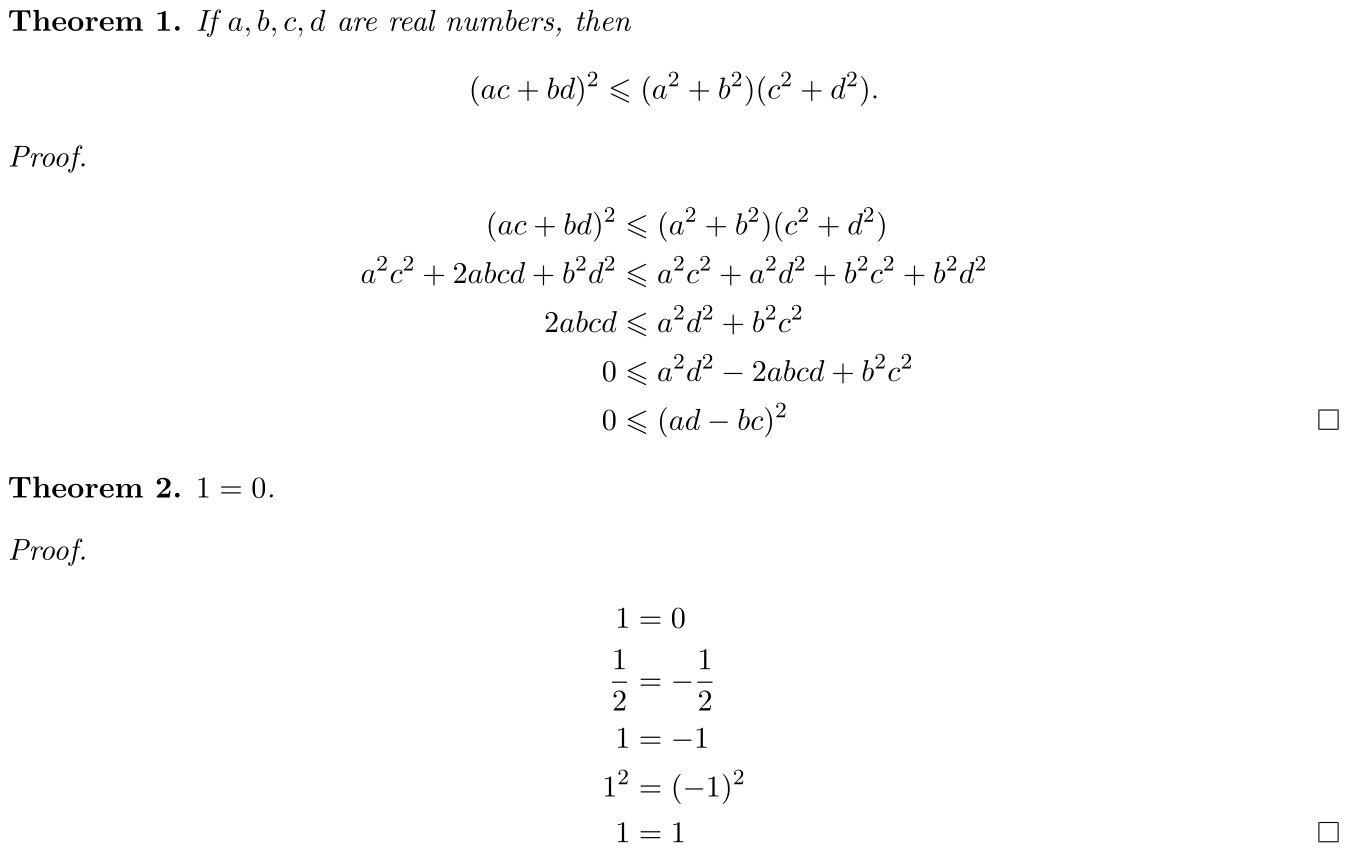 --- ## Proof by induction Useful for proving a statement about all positive integers. <span style="font-size:70%">eg: For all $n\in\mathbb{N}$, the last digit of $5^n$ is $5$.</span> Comprised of: * <span style="font-size:80%">base case: Statement is true for number $1$.</span><br> <span style="font-size:70%">eg: $5^1=5$, whose last digit is $5$.</span> * <span style="font-size:80%">step: If statement is true number $n$, then it is true for number $n+1$.</span><br> <span style="font-size:70%">eg: if $5^n=10a+5$ for some $a\in\mathbb{Z}$, then $5^{n+1} = 5(10a+5)=50a+25=10(5a+2)+5$, whose last digit is $5$.</span> * <span style="font-size:80%">Conclusion: "Hence, by induction, [statement] is true for all $n\in\mathbb{N}$."</span> --- ## Example 2 of induction #### Theorem For all $n\in\mathbb{N}$, $5^{2n}-1$ is a multiple of $3$. #### Proof: Base case <span style="font-size:80%">$5^{2\times1}-1 = 25-1 = 24 = 3\times8$, which is divisible by $3$.</span> <!-- .slide: data-auto-animate --> --- ## Example 2 of induction #### Theorem For all $n\in\mathbb{N}$, $5^{2n}-1$ is a multiple of $3$. #### Proof: Inductive step <span style="font-size:80%">Suppose that, for some particular $n\in\mathbb{N}$, $5^{2n}-1$ is a multiple of $3$.</span> <span style="font-size:80%">Then $\exists c\in\mathbb{Z}:5^{2n}-1 = 3c$.</span> <span style="font-size:80%">Therefore, $5^{2(n+1)}-1 = 25 (5^{2n}) - 1 = 25 (5^{2n}-1) + 25 - 1 = 25(3c) + 24 = 3(25c) + 3(8)$, which is also divisible by $3$.</span> <!-- .slide: data-auto-animate --> --- ## Example 2 of induction #### Theorem For all $n\in\mathbb{N}$, $5^{2n}-1$ is a multiple of $3$. #### Proof: Conclusion Hence, by induction, $5^{2n}-1$ is a multiple of $3$ is true for every $n\in\mathbb N$. <!-- .slide: data-auto-animate --> --- ## Anatomy of an inductive proof: eg. 2 #### Theorem <span class="fragment daz-switch preload" style="color: #191919" data-fragment-index="0">$Q(n)$</span><span class="fragment daz-switch preload" style="color: #191919" data-fragment-index="1">$Q(n)$</span><span class="fragment daz-switch preload" style="color: #191919" data-fragment-index="2">$Q(n)$</span><span class="fragment highlight-green daz-switch" style="text-transform: none" data-fragment-index="3">of form $\forall n \in\mathbb N$, $Q(n)$</span> For all $n\in\mathbb{N}$, <span class="fragment highlight-blue" data-fragment-index="1">$5^{2n}-1$ is a multiple of $3$</span>. #### Proof: Base case <span class="fragment daz-switch preload" style="color: #191919" data-fragment-index="0">$Q(n)$</span><span class="fragment daz-switch preload" style="color: #191919" data-fragment-index="1">$Q(n)$</span><span class="fragment daz-switch preload" style="color: #191919" data-fragment-index="2">$Q(n)$</span><span class="fragment highlight-green daz-switch" style="text-transform: none" data-fragment-index="3">of form $Q(1)$</span> <span class="fragment highlight-blue" data-fragment-index="2">$5^{2\times1}-1$</span> $= 25-1 = 24 = 3\times8$, which <span class="fragment highlight-blue" data-fragment-index="2">is divisible by $3$</span>. #### Proof: Inductive step <span class="fragment daz-switch preload" style="color: #191919" data-fragment-index="0">$Q(n)$</span><span class="fragment daz-switch preload" style="color: #191919" data-fragment-index="1">$Q(n)$</span><span class="fragment daz-switch preload" style="color: #191919" data-fragment-index="2">$Q(n)$</span><span class="fragment highlight-green daz-switch" style="text-transform: none" data-fragment-index="3">of form $Q(n)\implies Q(n+1)$</span> Suppose that, for some particular $n\in\mathbb{N}$, <span class="fragment highlight-blue" data-fragment-index="1">$5^{2n}-1$ is a multiple of $3$</span>. Then $\exists c\in\mathbb{Z}:5^{2n}-1 = 3c$. Therefore, <span class="fragment highlight-blue" data-fragment-index="2">$5^{2(n+1)}-1$</span> $ = 25 (5^{2n}) - 1 = 25 (5^{2n}-1) + 25 - 1 = 25(3c) + 24 = 3(25c) + 3(8)$, which <span class="fragment highlight-blue" data-fragment-index="2">is</span> also <span class="fragment highlight-blue" data-fragment-index="2">divisible by $3$</span>. #### Proof: Conclusion <span class="fragment daz-switch preload" style="color: #191919" data-fragment-index="0">$Q(n)$</span><span class="fragment daz-switch preload" style="color: #191919" data-fragment-index="1">$Q(n)$</span><span class="fragment daz-switch preload" style="color: #191919" data-fragment-index="2">$Q(n)$</span><span class="fragment highlight-green daz-switch" style="text-transform: none" data-fragment-index="3">of form Hence, by induction, $\forall n \in\mathbb N$, $Q(n)$</span> Hence, by induction, <span class="fragment highlight-blue" data-fragment-index="1">$5^{2n}-1$ is a multiple of $3$</span> is true for every $n\in\mathbb N$. <!-- .slide: class="smallertext" --> --- ## Anatomy of an inductive proof: eg. 1 #### Theorem <span class="fragment daz-switch preload" style="color: #191919" data-fragment-index="0">$Q(n)$</span><span class="fragment daz-switch preload" style="color: #191919" data-fragment-index="1">$Q(n)$</span><span class="fragment daz-switch preload" style="color: #191919" data-fragment-index="2">$Q(n)$</span><span class="fragment highlight-green daz-switch" style="text-transform: none" data-fragment-index="3">of form $\forall n \in\mathbb N$, $Q(n)$</span> For all $n\in\mathbb{N}$, <span class="fragment highlight-blue" data-fragment-index="1">the last digit of $5^n$ is $5$</span>. #### Proof: Base case <span class="fragment daz-switch preload" style="color: #191919" data-fragment-index="0">$Q(n)$</span><span class="fragment daz-switch preload" style="color: #191919" data-fragment-index="1">$Q(n)$</span><span class="fragment daz-switch preload" style="color: #191919" data-fragment-index="2">$Q(n)$</span><span class="fragment highlight-green daz-switch" style="text-transform: none" data-fragment-index="3">of form $Q(1)$</span> <span class="fragment highlight-blue" data-fragment-index="2">$5^1$</span>$=5$, <span class="fragment highlight-blue" data-fragment-index="2">whose last digit is $5$</span>. #### Proof: Inductive step <span class="fragment daz-switch preload" style="color: #191919" data-fragment-index="0">$Q(n)$</span><span class="fragment daz-switch preload" style="color: #191919" data-fragment-index="1">$Q(n)$</span><span class="fragment daz-switch preload" style="color: #191919" data-fragment-index="2">$Q(n)$</span><span class="fragment highlight-green daz-switch" style="text-transform: none" data-fragment-index="3">of form $Q(n)\implies Q(n+1)$</span> If <span class="fragment highlight-blue" data-fragment-index="1">$5^n=10a+5$ for some $a\in\mathbb{Z}$</span>, then <span class="fragment highlight-blue" data-fragment-index="2">$5^{n+1}$</span> $= 5(10a+5)=50a+25=10(5a+2)+5$ <span class="fragment highlight-blue" data-fragment-index="2">whose last digit is $5$</span>. #### Proof: Conclusion <span class="fragment daz-switch preload" style="color: #191919" data-fragment-index="0">$Q(n)$</span><span class="fragment daz-switch preload" style="color: #191919" data-fragment-index="1">$Q(n)$</span><span class="fragment daz-switch preload" style="color: #191919" data-fragment-index="2">$Q(n)$</span><span class="fragment highlight-green daz-switch" style="text-transform: none" data-fragment-index="3">of form Hence, by induction, $\forall n \in\mathbb N$, $Q(n)$</span> Hence, by induction, <span class="fragment highlight-blue" data-fragment-index="1">$5^{n}$ is divisible by $5$</span> is true for every $n\in\mathbb N$. <!-- .slide: class="smallertext" --> --- ## Anatomy of an inductive proof: demonstration <span style="color: #dd0000">I need 5 volunteers!</span> #### Theorem of form $\forall n \in\mathbb N$, $Q(n)$ #### Proof: Base case of form $Q(1)$ #### Proof: Inductive step of form $Q(n)\implies Q(n+1)$ #### Proof: Conclusion Hence, by induction, $\forall n \in\mathbb N$, $Q(n)$ <!-- .slide: data-auto-animate class="smallertext" --> --- ## Anatomy of an inductive proof: demonstration <span style="color: #dd0000">I need 5 volunteers!</span> #### Theorem of form $\forall n \in\mathbb N$, $Q(n)$ #### Proof: Different base case of form $Q(3)$ #### Proof: Inductive step of form $Q(n)\implies Q(n+1)$ #### Proof: Conclusion Hence, by induction, $\forall$ integers $n\geqslant3$, $Q(n)$ <!-- .slide: data-auto-animate class="smallertext" --> --- ## More proofs(?) by induction 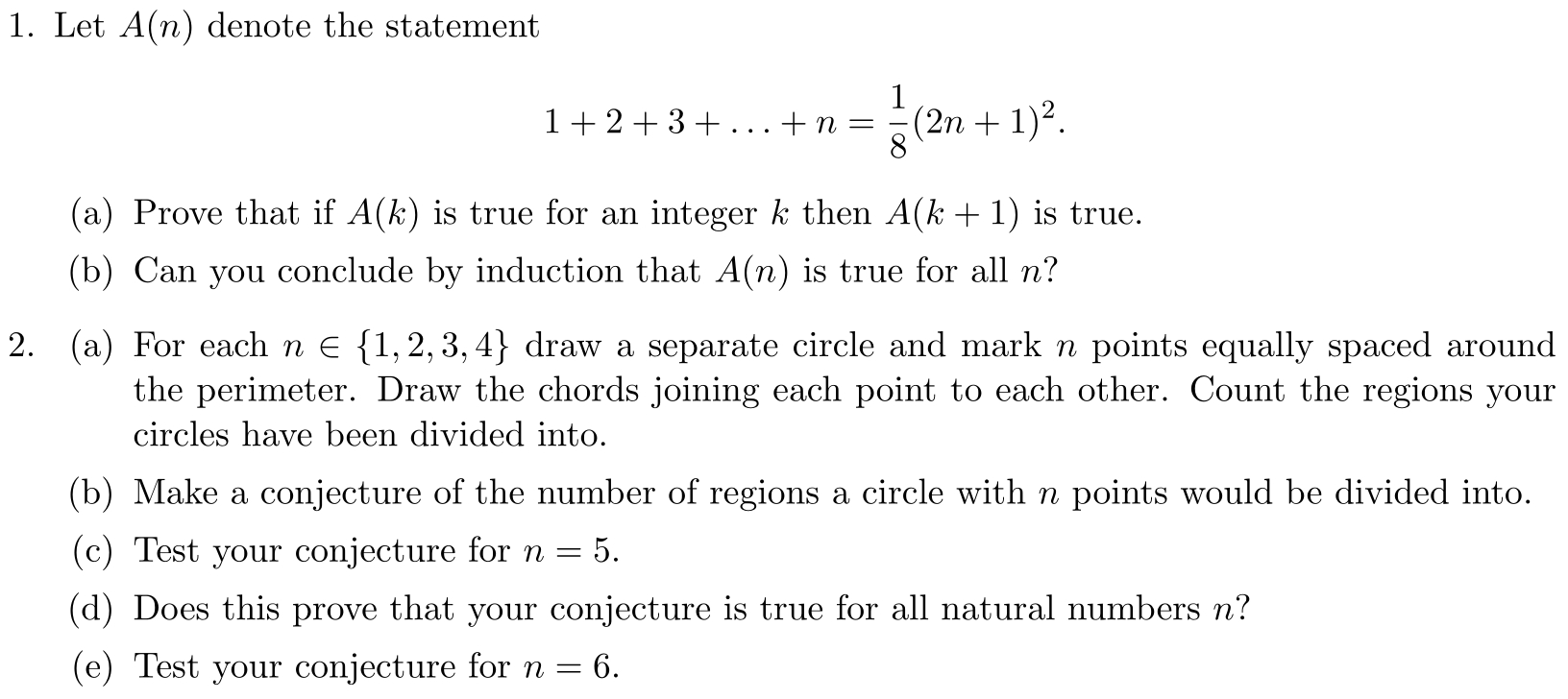 --- ## Another proof(?) by induction 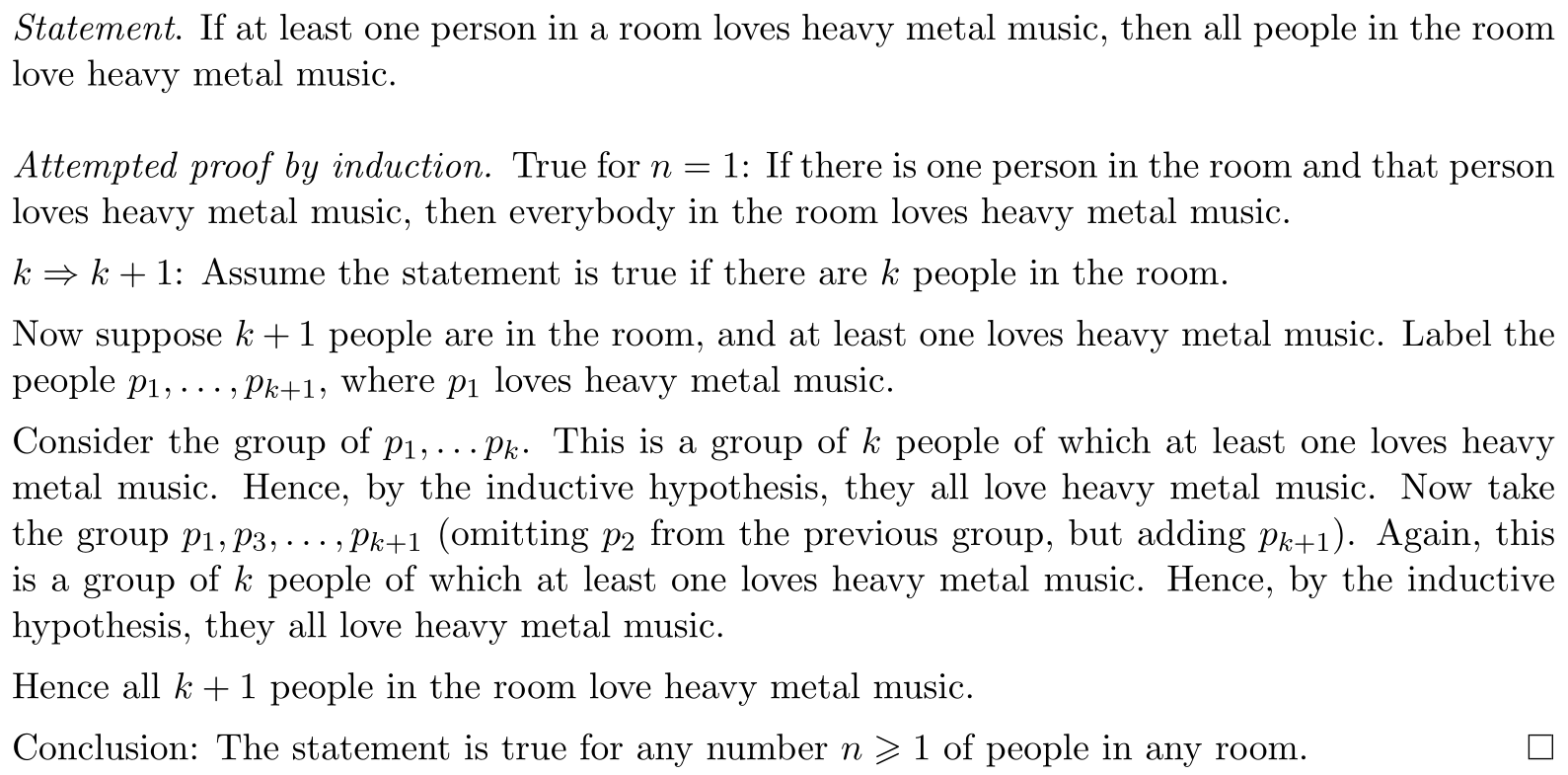 --- ## Sequences: motivation $(x,y)$, $(x,y,z)$ are ordered pair and ordered triplet. $(a,b,c,d,e,f,g)$ is an ordered heptuplet. $(a_1,a_2,a_3,\ldots,a_n)=(a_j)_{j=1}^n$ is an ordered $n$-tuplet. $(a_1,a_2,a_3,\ldots)$, usually written $\\{a_j\\}\_{j=1}^\infty$ is an infinite *sequence*. --- ## Sequences: Examples * $(7,14,21,28,35,\ldots) = \\{7n\\}\_{n=1}^\infty$ * $\\{a_n\\}\_{n=1}^\infty$ defined by $a\_n = \frac{(-1)^n}n$ * $\\{c_n\\}\_{n=1}^\\infty$ where $c\_{2j}=j^2$ and $c\_{2j-1}=\frac{1}{j^2}$ Then $(a_1, a_2, a_3, a_4, a_5, a\_{100}) = $ ? $(c_1, c_2, c_3, c_4, c_5, c\_{100}) = $ ? <!-- .slide: data-auto-animate --> --- ## Sequences: Examples * $(7,14,21,28,35,\ldots) = \\{7n\\}\_{n=1}^\infty$ * $\\{a_n\\}\_{n=1}^\infty$ defined by $a\_n = \frac{(-1)^n}n$ * $\\{c_n\\}\_{n=1}^\\infty$ where $c\_{2j}=j^2$ and $c\_{2j-1}=\frac{1}{j^2}$ Then $(a_1, a_2, a_3, a_4, a_5, a\_{100}) = (-1,\frac12,\frac{-1}3,\frac14,\frac{-1}5,\frac1{100})$ $(c_1, c_2, c_3, c_4, c_5, c\_{100}) = (1,1,\frac14,4,\frac19,2500)$ <!-- .slide: data-auto-animate --> --- ## Assignments and assessment 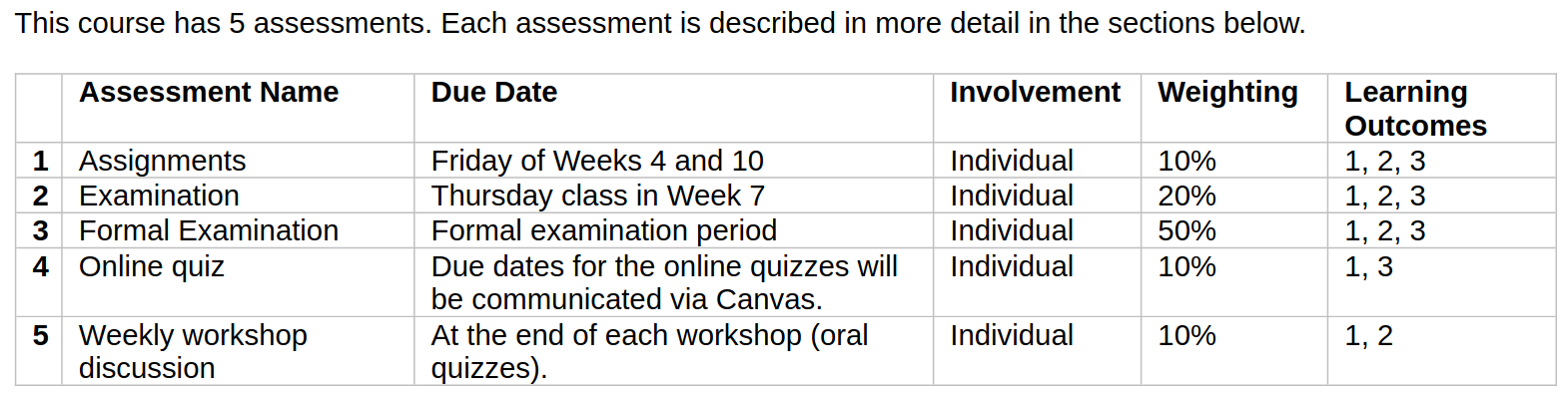 Online quiz: 11 assessments, 1 per week, best BEFORE the Thursday lecture. Unlimited attempts Weekly workshop discussion: 11 assessments, 1 per week, completed by contributing to your workshop discussion. Each of these assessments is worth relatively little; they are designed to encourage you to manage your learning in a productive way. <!-- .slide: class="smallertext" --> --- ## Bounded sequences #### Definition A sequence $\\{a_n\\}\_{n=1}^\infty$ is *bounded* if there exists some $M\geq0$ such that, for all $n\in\mathbb N$, $\lvert a_n \rvert \leq M$. We call $M$ a *bound* for $\\{a_n\\}\_{n=1}^\infty$. #### Examples If $a_n = \frac3n$, then $3$ is a bound for $\\{a_n\\}\_{n=1}^\infty$. If $b_n = \frac{3n}{n^2+1}$, then $5$ is a bound for $\\{b_n\\}\_{n=1}^\infty$, and so is $2$. If $c_n = -n^3$, then what is a bound for $\\{c_n\\}\_{n=1}^\infty$? If $d_n = 1-\frac1n$, then what is a bound for $\\{d_n\\}\_{n=1}^\infty$? #### Smallest bound We do not need the smallest bound for this course; see MATH2350. <!-- .slide: class="smallertext" --> --- ## Proof of a bound #### Theorem If $d_n = 1-\frac1n$, then $1$ is a bound for $\\{d_n\\}\_{n=1}^\infty$. #### Proof We aim to show that, for all $n\in\mathbb N$, both $-1 \leqslant 1-\frac1n$ and $1-\frac1n \leqslant 1$. <div style="display:flex;flex-direction:row;width:100%"> <div style="flex:1;margin-right:2vw"> \\[\begin{aligned} & & n & \geqslant 1 \\\\ & \implies & 1 & \geqslant \frac1n \\\\ & \implies & -1 & \leqslant -\frac1n \\\\ & \implies & 0 & \leqslant 1-\frac1n \end{aligned} \\] </div> <div style="flex:1;margin-left:2vw"> \\[\begin{aligned} & & 1 & > 0 \\\\ & \implies & \frac1n & > 0 \\\\ & \implies & -\frac1n & < 0 \\\\ & \implies & 1-\frac1n & < 1 \end{aligned} \\] </div> </div> We have shown stronger statements than we needed. <!-- .slide: class="smallertext" --> --- ## Deriving the proof of a bound We aim to show that, for all $n\in\mathbb N$, $-1 \leqslant 1-\frac1n$. <div style="display:flex;flex-direction:row;width:100%"> <div style="flex:1;margin-right:2vw;border-right: 2px solid var(--r-main-color);"> The final proof is \\[\begin{aligned} & & n & \geqslant 1 \\\\ & \implies & 1 & \geqslant \frac1n \\\\ & \implies & -1 & \leqslant -\frac1n \\\\ & \implies & 0 & \leqslant 1-\frac1n \end{aligned} \\] </div> <div style="flex:1;margin-left:2vw;border-right: 2px solid var(--r-main-color);"> But to work this out we do \\[\begin{aligned} & & -1 & \leqslant 1-\frac1n \\\\ & \implies & \frac1n & \leqslant 2 \\\\ & \implies & \frac12 & \leqslant n, \end{aligned} \\] which is true. </div> <div style="flex:1;margin-left:2vw"> Then make this a proof by \\[\begin{aligned} & & -1 & \leqslant 1-\frac1n \\\\ & \impliedby & \frac1n & \leqslant 2 \\\\ & \impliedby & \frac12 & \leqslant n, \end{aligned} \\] which is true. </div> </div> Then we can reorder and tighten the bound if we want, but it is not required. <!-- .slide: class="smallertext" --> --- ## Deriving the proof of a bound: your turn We aim to show that, for all $n\in\mathbb N$, $1-\frac1n \leqslant 1$. <div style="display:flex;flex-direction:row;width:100%"> <div style="flex:1;margin-right:2vw;border-right: 2px solid var(--r-main-color);"> The final proof is \\[\begin{aligned} & & 1 & > 0 \\\\ & \implies & \frac1n & > 0 \\\\ & \implies & -\frac1n & < 0 \\\\ & \implies & 1-\frac1n & < 1 \end{aligned} \\] as required. </div> <div class="fragment daz-switch preload" data-fragment-index="0" style="flex:1;margin-left:2vw;border-right: 2px solid var(--r-main-color);"> But to work this out we do \\[\begin{aligned} & & 1-\frac1n & \leqslant 1 \\\\ & \implies & &? \\\\ & & &\phantom{\leqslant 0,} \end{aligned} \\] </div> <div class="fragment daz-switch" data-fragment-index="1" style="flex:1;margin-left:2vw;border-right: 2px solid var(--r-main-color);"> But to work this out we do \\[\begin{aligned} & & 1-\frac1n & \leqslant 1 \\\\ & \implies & -\frac1n & \leqslant 0 \\\\ & \implies & \frac1n & \geqslant 0 \\\\ & \implies & 1 & \geqslant 0, \end{aligned} \\] which is true. </div> <div class="fragment daz-switch preload" data-fragment-index="0" style="flex:1;margin-left:2vw"> Then make this a proof by \\[\begin{aligned} & & 1-\frac1n & \leqslant 1 \\\\ & \phantom{\implies} & & ? \\\\ & & &\phantom{\leqslant 0,} \end{aligned} \\] </div> <div class="fragment daz-switch" data-fragment-index="1" style="flex:1;margin-left:2vw"> Then make this a proof by \\[\begin{aligned} & & 1-\frac1n & \leqslant 1 \\\\ & \impliedby & -\frac1n & \leqslant 0 \\\\ & \impliedby & \frac1n & \geqslant 0 \\\\ & \impliedby & 1 & \geqslant 0, \end{aligned} \\] which is true. </div> </div> Then we can reorder and tighten the bound. <!-- .slide: class="smallertext" --> --- ## Distance between real numbers Suppose $x,y\in\mathbb R$. Then $\lvert x-y \rvert$ is the *distance* between them. Note $\lvert x-y \rvert = \lvert y-x \rvert$, as appropriate for a distance. So "$\lvert x-y \rvert < 5$" means "$x$ and $y$ are within $5$ of each other". cf. vectors: $\lVert\mathbf x -\mathbf y\rVert$ is the distance between two vectors, the length of the vector starting from $\mathbf y$ and going to $\mathbf x$. --- ## Limit of a sequence #### Definition A sequence $\\{a_n\\}\_{n=1}^\infty$ *converges* to *limit* $\ell\in\mathbb R$ if for all $\varepsilon>0$, $\exists k\in\mathbb N$ such that $n>k \implies$ $\lvert a_n-\ell \rvert < \varepsilon$. If so, we say "$\displaystyle\lim\_{n\to\infty} a_n = \ell$" or "$a_n\to\ell$ as $n\to\infty$". Informally, we think of a limit as "something that the terms in the sequence get closer and closer to". But we need a more precise understanding for this course. #### Examples If $a_n = \frac{-1}n$, then $\displaystyle\lim\_{n\to\infty} a_n = 0$. If $b_n = \frac{n+3}{5-2n}$, then $\displaystyle\lim\_{n\to\infty} b_n = \frac{-1}2$. <!-- .slide: class="smallertext" data-transition="slide-in none-out" --> --- ## Limit of a sequence #### Definition A sequence $\\{a_n\\}\_{n=1}^\infty$ *converges* to *limit* $\ell\in\mathbb R$ if <span style="color:var(--uswds-red-cool-20)">for all $\varepsilon>0$</span>, <span style="color:var(--uswds-indigo-20)">$\exists k\in\mathbb N$ such that</span> <span style="color:var(--uswds-green-cool-20)">$n>k \implies$</span> <span style="color:var(--uswds-gold-20)">$\lvert a_n-\ell \rvert < \varepsilon$</span>. #### Or, in words, <span style="color:var(--uswds-red-cool-20)">No matter how small we pick $\varepsilon>0$</span>, <span style="color:var(--uswds-indigo-20)">we can always go far enough (ie. $k$ far) down the sequence to ensure that</span> <span style="color:var(--uswds-green-cool-20)">every term after that point (ie. after $k$)</span>, <span style="color:var(--uswds-gold-20)">is within $\varepsilon$ of $\ell$</span>. #### How to prove convergence if you know the limit Construct a machine (a function) that <span style="color:var(--uswds-indigo-20)">tells you $k$</span> <span style="color:var(--uswds-red-cool-20)">for any given $\varepsilon$</span>, and that $k$ <span style="color:var(--uswds-gold-20)">d</span><span style="color:var(--uswds-green-cool-20)">o</span><span style="color:var(--uswds-gold-20)">e</span><span style="color:var(--uswds-green-cool-20)">s</span><span style="color:var(--uswds-gold-20)"> t</span><span style="color:var(--uswds-green-cool-20)">h</span><span style="color:var(--uswds-gold-20)">e</span><span style="color:var(--uswds-green-cool-20)"> j</span><span style="color:var(--uswds-gold-20)">o</span><span style="color:var(--uswds-green-cool-20)">b</span>. <!-- .slide: class="smallertext" data-transition="none-in slide-out" --> --- ## Proof of sequence limit: example 1 #### Theorem If $a_n = \frac{-1}n$, then $\displaystyle\lim\_{n\to\infty} a_n = 0$. #### Definition A sequence $\\{a_n\\}\_{n=1}^\infty$ *converges* to *limit* $\ell\in\mathbb R$ if <span style="color:var(--uswds-red-cool-20)">for all $\varepsilon>0$</span>, <span style="color:var(--uswds-indigo-20)">$\exists k\in\mathbb N$ such that</span> <span style="color:var(--uswds-green-cool-20)">$n>k \implies$</span> <span style="color:var(--uswds-gold-20)">$\lvert a_n-\ell \rvert < \varepsilon$</span>. #### How to prove convergence if you know the limit Construct a machine (a function) that <span style="color:var(--uswds-indigo-20)">tells you $k$</span> <span style="color:var(--uswds-red-cool-20)">for any given $\varepsilon$</span>, and that $k$ <span style="color:var(--uswds-gold-20)">d</span><span style="color:var(--uswds-green-cool-20)">o</span><span style="color:var(--uswds-gold-20)">e</span><span style="color:var(--uswds-green-cool-20)">s</span><span style="color:var(--uswds-gold-20)"> t</span><span style="color:var(--uswds-green-cool-20)">h</span><span style="color:var(--uswds-gold-20)">e</span><span style="color:var(--uswds-green-cool-20)"> j</span><span style="color:var(--uswds-gold-20)">o</span><span style="color:var(--uswds-green-cool-20)">b</span>. #### Proof Fix <span style="color:var(--uswds-red-cool-20)">any $\varepsilon>0$</span>. <span style="color:var(--uswds-indigo-20)">Let $k=\lceil\frac1\varepsilon\rceil$</span>. <span style="color:var(--uswds-green-cool-20)">If $n>k$, then</span> <span style="color:var(--uswds-gold-20)">$\lvert a_n - \ell \rvert$</span> $= \lvert \frac{-1}n - 0 \rvert = \frac1n$ <span style="color:var(--uswds-gold-20)">$<$</span> $\frac 1k = \frac1{\lceil1/\varepsilon\rceil} \leqslant \frac1{1/\varepsilon} =$ <span style="color:var(--uswds-gold-20)">$\varepsilon$</span>. □ <!-- .slide: class="smallertext" --> --- ## Proof of sequence limit: example 2 #### Theorem If $b_n = \frac{n+3}{5-2n}$, then $\displaystyle\lim\_{n\to\infty} a_n = \tfrac{-1}2$. #### Definition A sequence $\\{a_n\\}\_{n=1}^\infty$ *converges* to *limit* $\ell\in\mathbb R$ if <span style="color:var(--uswds-red-cool-20)">for all $\varepsilon>0$</span>, <span style="color:var(--uswds-indigo-20)">$\exists k\in\mathbb N$ such that</span> <span style="color:var(--uswds-green-cool-20)">$n>k \implies$</span> <span style="color:var(--uswds-gold-20)">$\lvert a_n-\ell \rvert < \varepsilon$</span>. #### How to prove convergence if you know the limit Construct a machine (a function) that <span style="color:var(--uswds-indigo-20)">tells you $k$</span> <span style="color:var(--uswds-red-cool-20)">for any given $\varepsilon$</span>, and that $k$ <span style="color:var(--uswds-gold-20)">d</span><span style="color:var(--uswds-green-cool-20)">o</span><span style="color:var(--uswds-gold-20)">e</span><span style="color:var(--uswds-green-cool-20)">s</span><span style="color:var(--uswds-gold-20)"> t</span><span style="color:var(--uswds-green-cool-20)">h</span><span style="color:var(--uswds-gold-20)">e</span><span style="color:var(--uswds-green-cool-20)"> j</span><span style="color:var(--uswds-gold-20)">o</span><span style="color:var(--uswds-green-cool-20)">b</span>. #### Proof Fix <span style="color:var(--uswds-red-cool-20)">any $\varepsilon>0$</span>. <span style="color:var(--uswds-indigo-20)">Let $k=\max\\{10,\lceil\frac{11}{3\varepsilon}\rceil\\}$</span>. <span style="color:var(--uswds-green-cool-20)">If $n>k$, then</span> <span style="color:var(--uswds-gold-20)">$\lvert b_n - \ell \rvert$</span> $= \lvert \frac{n+3}{5-2n}-\frac{-1}2 \rvert = \lvert\frac{(2n+6)+(5-2n)}{10-4n}\rvert=\lvert\frac{11}{10-4n}\rvert = \frac{11}{4n-10} < \frac{11}{3n}$ <span style="color:var(--uswds-gold-20)">$<$</span> $\frac{11}{3k} \leqslant \frac{11}{3\lceil11/3\varepsilon\rceil} \leqslant \frac{11}{3(11/3\varepsilon)} =$ <span style="color:var(--uswds-gold-20)">$\varepsilon$</span>. □ <!-- .slide: class="smallertext" --> --- ## Deriving proof of sequence limit: eg 1 Theorem: If $a_n = \frac{-1}n$, then $\displaystyle\lim\_{n\to\infty} a_n = 0$. #### How to prove convergence if you know the limit Construct a machine (a function) that <span style="color:var(--uswds-indigo-20)">tells you $k$</span> <span style="color:var(--uswds-red-cool-20)">for any given $\varepsilon$</span>, and that $k$ <span style="color:var(--uswds-gold-20)">d</span><span style="color:var(--uswds-green-cool-20)">o</span><span style="color:var(--uswds-gold-20)">e</span><span style="color:var(--uswds-green-cool-20)">s</span><span style="color:var(--uswds-gold-20)"> t</span><span style="color:var(--uswds-green-cool-20)">h</span><span style="color:var(--uswds-gold-20)">e</span><span style="color:var(--uswds-green-cool-20)"> j</span><span style="color:var(--uswds-gold-20)">o</span><span style="color:var(--uswds-green-cool-20)">b</span>. #### Rough work Fix <span style="color:var(--uswds-red-cool-20)">any $\varepsilon>0$</span>. Aim to define $k\in\mathbb N$ such that <span style="color:var(--uswds-green-cool-20)">$n>k \implies$</span> <span style="color:var(--uswds-gold-20)">$\lvert a_n-\ell \rvert < \varepsilon$</span>. I can calculate <span style="color:var(--uswds-gold-20)">$\lvert a_n - \ell \rvert$</span> $= \lvert \frac{-1}n - 0 \rvert = \frac1n$, and I want this to be <span style="color:var(--uswds-gold-20)">$<\varepsilon$</span>. I may require <span style="color:var(--uswds-green-cool-20)">$n>k$</span>, so that $\frac1n<\frac1k$, so <span style="color:var(--uswds-gold-20)">$\lvert a_n - \ell \rvert<$</span> $\frac1k$, so now I just need $\frac1k\leqslant\varepsilon$. First guess: $k = \frac1\varepsilon$. This gives $\frac1k\leqslant\varepsilon$ as I wanted, but probably $\frac1\varepsilon \notin \mathbb N$. So use <span style="color:var(--uswds-indigo-20)">$k = \lceil\frac1\varepsilon\rceil$</span>. <!-- .slide: class="smallertext" data-auto-animate --> --- ## Deriving proof of sequence limit: eg 1 Theorem: If $a_n = \frac{-1}n$, then $\displaystyle\lim\_{n\to\infty} a_n = 0$. #### Rough work Fix <span style="color:var(--uswds-red-cool-20)">any $\varepsilon>0$</span>. Aim to define $k\in\mathbb N$ such that <span style="color:var(--uswds-green-cool-20)">$n>k \implies$</span> <span style="color:var(--uswds-gold-20)">$\lvert a_n-\ell \rvert < \varepsilon$</span>. I can calculate <span style="color:var(--uswds-gold-20)">$\lvert a_n - \ell \rvert$</span> $= \lvert \frac{-1}n - 0 \rvert = \frac1n$, and I want this to be <span style="color:var(--uswds-gold-20)">$<\varepsilon$</span>. I may require <span style="color:var(--uswds-green-cool-20)">$n>k$</span>, so that $\frac1n<\frac1k$, so <span style="color:var(--uswds-gold-20)">$\lvert a_n - \ell \rvert<$</span> $\frac1k$, so now I just need $\frac1k\leqslant\varepsilon$. First guess: $k = \frac1\varepsilon$. This gives $\frac1k\leqslant\varepsilon$ as I wanted, but probably $\frac1\varepsilon \notin \mathbb N$. So use <span style="color:var(--uswds-indigo-20)">$k = \lceil\frac1\varepsilon\rceil$</span>. #### Proof Fix <span style="color:var(--uswds-red-cool-20)">any $\varepsilon>0$</span>. <span style="color:var(--uswds-indigo-20)">Let $k=\lceil\frac1\varepsilon\rceil$</span>. <span style="color:var(--uswds-green-cool-20)">If $n>k$, then</span> <span style="color:var(--uswds-gold-20)">$\lvert a_n - \ell \rvert$</span> $= \lvert \frac{-1}n - 0 \rvert = \frac1n$ <span style="color:var(--uswds-gold-20)">$<$</span> $\frac 1k = \frac1{\lceil1/\varepsilon\rceil} \leqslant \frac1{1/\varepsilon} =$ <span style="color:var(--uswds-gold-20)">$\varepsilon$</span>. □ <!-- .slide: class="smallertext" data-auto-animate --> --- ## Deriving proof of sequence limit: eg 2 Theorem: If $b_n = \frac{n+3}{5-2n}$, then $\displaystyle\lim\_{n\to\infty} b_n = \frac{-1}2$. #### How to prove convergence if you know the limit Construct a machine (a function) that <span style="color:var(--uswds-indigo-20)">tells you $k$</span> <span style="color:var(--uswds-red-cool-20)">for any given $\varepsilon$</span>, and that $k$ <span style="color:var(--uswds-gold-20)">d</span><span style="color:var(--uswds-green-cool-20)">o</span><span style="color:var(--uswds-gold-20)">e</span><span style="color:var(--uswds-green-cool-20)">s</span><span style="color:var(--uswds-gold-20)"> t</span><span style="color:var(--uswds-green-cool-20)">h</span><span style="color:var(--uswds-gold-20)">e</span><span style="color:var(--uswds-green-cool-20)"> j</span><span style="color:var(--uswds-gold-20)">o</span><span style="color:var(--uswds-green-cool-20)">b</span>. #### Rough work Fix <span style="color:var(--uswds-red-cool-20)">any $\varepsilon>0$</span>. Aim to define $k\in\mathbb N$ such that <span style="color:var(--uswds-green-cool-20)">$n>k \implies$</span> <span style="color:var(--uswds-gold-20)">$\lvert b_n-\ell \rvert < \varepsilon$</span>. Calculate <span style="color:var(--uswds-gold-20)">$\lvert b_n - \ell \rvert$</span> $= \lvert \frac{n+3}{5-2n}-\frac{-1}2 \rvert = \lvert\frac{(2n+6)+(5-2n)}{10-4n}\rvert=\lvert\frac{11}{10-4n}\rvert$, and I want to simplify. If I assume <span style="color:var(--uswds-green-cool-20)">$4n>10$</span>, then $\lvert\frac{11}{10-4n}\rvert=\frac{11}{4n-10}$. If I assume <span style="color:var(--uswds-green-cool-20)">$n>10$</span>, then $\frac{11}{4n-10}<\frac{11}{3n}$, and I want this to be <span style="color:var(--uswds-gold-20)">$<\varepsilon$</span>. I may require <span style="color:var(--uswds-green-cool-20)">$n>t$</span>, so that $\frac{11}{3n}<\frac{11}{3t}$, so <span style="color:var(--uswds-gold-20)">$\lvert b_n - \ell \rvert<$</span> $\frac{11}{3t}$, so now I just need $\frac{11}{3t}\leqslant\varepsilon$. First guess: $t = \frac{11}{3\varepsilon}$. This gives $\frac{11}{3t}\leqslant\varepsilon$ as I wanted, but probably $\frac{11}{3\varepsilon} \notin \mathbb N$. So use $t = \lceil\frac{11}{3\varepsilon}\rceil$. <!-- .slide: class="smallertext" data-auto-animate data-auto-animate-restart --> --- ## Deriving proof of sequence limit: eg 2 #### Rough work Fix <span style="color:var(--uswds-red-cool-20)">any $\varepsilon>0$</span>. Aim to define $k\in\mathbb N$ such that <span style="color:var(--uswds-green-cool-20)">$n>k \implies$</span> <span style="color:var(--uswds-gold-20)">$\lvert b_n-\ell \rvert < \varepsilon$</span>. Calculate <span style="color:var(--uswds-gold-20)">$\lvert b_n - \ell \rvert$</span> $= \lvert \frac{n+3}{5-2n}-\frac{-1}2 \rvert = \lvert\frac{(2n+6)+(5-2n)}{10-4n}\rvert=\lvert\frac{11}{10-4n}\rvert$, and I want to simplify. If I assume <span style="color:var(--uswds-green-cool-20)">$4n>10$</span>, then $\lvert\frac{11}{10-4n}\rvert=\frac{11}{4n-10}$. If I assume <span style="color:var(--uswds-green-cool-20)">$n>10$</span>, then $\frac{11}{4n-10}<\frac{11}{3n}$, and I want this to be <span style="color:var(--uswds-gold-20)">$<\varepsilon$</span>. I may require <span style="color:var(--uswds-green-cool-20)">$n>t$</span>, so that $\frac{11}{3n}<\frac{11}{3t}$, so <span style="color:var(--uswds-gold-20)">$\lvert b_n - \ell \rvert<$</span> $\frac{11}{3t}$, so now I just need $\frac{11}{3t}\leqslant\varepsilon$. First guess: $t = \frac{11}{3\varepsilon}$. This gives $\frac{11}{3t}\leqslant\varepsilon$ as I wanted, but probably $\frac{11}{3\varepsilon} \notin \mathbb N$. So use <span style="color:var(--uswds-indigo-20)">$t = \lceil\frac{11}{3\varepsilon}\rceil$</span>. #### Summary If <span style="color:var(--uswds-green-cool-20)">$4n>10$ and $n>10$ and $n>t=\lceil\frac{11}{3\varepsilon}\rceil$, then</span> I can show that <span style="color:var(--uswds-gold-20)">$\lvert b_n - \ell \rvert<\varepsilon$</span>. So I pick <span style="color:var(--uswds-indigo-20)">$k =$</span> $\max\\{ \frac{10}4, 10, \lceil\frac{11}{3\varepsilon}\rceil \\} =$ <span style="color:var(--uswds-indigo-20)">$\max\\{ 10, \lceil\frac{11}{3\varepsilon}\rceil \\}$</span>. <!-- .slide: class="smallertext" data-auto-animate --> --- ## Deriving proof of sequence limit: eg 2 #### Rough work Fix <span style="color:var(--uswds-red-cool-20)">any $\varepsilon>0$</span>. Aim to define $k\in\mathbb N$ such that <span style="color:var(--uswds-green-cool-20)">$n>k \implies$</span> <span style="color:var(--uswds-gold-20)">$\lvert b_n-\ell \rvert < \varepsilon$</span>. Calculate <span style="color:var(--uswds-gold-20)">$\lvert b_n - \ell \rvert$</span> $= \lvert \frac{n+3}{5-2n}-\frac{-1}2 \rvert = \lvert\frac{(2n+6)+(5-2n)}{10-4n}\rvert=\lvert\frac{11}{10-4n}\rvert$, and I want to simplify. If I assume <span style="color:var(--uswds-green-cool-20)">$4n>10$</span>, then $\lvert\frac{11}{10-4n}\rvert=\frac{11}{4n-10}$. If I assume <span style="color:var(--uswds-green-cool-20)">$n>10$</span>, then $\frac{11}{4n-10}<\frac{11}{3n}$, and I want this to be <span style="color:var(--uswds-gold-20)">$<\varepsilon$</span>. I may require <span style="color:var(--uswds-green-cool-20)">$n>t$</span>, so that $\frac{11}{3n}<\frac{11}{3t}$, so <span style="color:var(--uswds-gold-20)">$\lvert b_n - \ell \rvert<$</span> $\frac{11}{3t}$, so now I just need $\frac{11}{3t}\leqslant\varepsilon$. First guess: $t = \frac{11}{3\varepsilon}$. This gives $\frac{11}{3t}\leqslant\varepsilon$ as I wanted, but probably $\frac{11}{3\varepsilon} \notin \mathbb N$. So use <span style="color:var(--uswds-indigo-20)">$t = \lceil\frac{11}{3\varepsilon}\rceil$</span>. #### Proof Fix <span style="color:var(--uswds-red-cool-20)">any $\varepsilon>0$</span>. <span style="color:var(--uswds-indigo-20)">Let $k=\max\\{10,\lceil\frac{11}{3\varepsilon}\rceil\\}$</span>. <span style="color:var(--uswds-green-cool-20)">If $n>k$, then</span> <span style="color:var(--uswds-gold-20)">$\lvert b_n - \ell \rvert$</span> $= \lvert \frac{n+3}{5-2n}-\frac{-1}2 \rvert = \lvert\frac{(2n+6)+(5-2n)}{10-4n}\rvert=\lvert\frac{11}{10-4n}\rvert = \frac{11}{4n-10} < \frac{11}{3n}$ <span style="color:var(--uswds-gold-20)">$<$</span> $\frac{11}{3k} \leqslant \frac{11}{3\lceil11/3\varepsilon\rceil} \leqslant \frac{11}{3(11/3\varepsilon)} =$ <span style="color:var(--uswds-gold-20)">$\varepsilon$</span>. □ <!-- .slide: class="smallertext" data-auto-animate --> --- ## Deriving proof of sequence limit: your turn 1 Theorem: If $c_n = 1+\frac{(-1)^n}{6 n}$, then $\displaystyle\lim\_{n\to\infty} c_n = 1$. #### How to prove convergence if you know the limit Construct a machine (a function) that <span style="color:var(--uswds-indigo-20)">tells you $k$</span> <span style="color:var(--uswds-red-cool-20)">for any given $\varepsilon$</span>, and that $k$ <span style="color:var(--uswds-gold-20)">d</span><span style="color:var(--uswds-green-cool-20)">o</span><span style="color:var(--uswds-gold-20)">e</span><span style="color:var(--uswds-green-cool-20)">s</span><span style="color:var(--uswds-gold-20)"> t</span><span style="color:var(--uswds-green-cool-20)">h</span><span style="color:var(--uswds-gold-20)">e</span><span style="color:var(--uswds-green-cool-20)"> j</span><span style="color:var(--uswds-gold-20)">o</span><span style="color:var(--uswds-green-cool-20)">b</span>. #### Rough work Fix <span style="color:var(--uswds-red-cool-20)">any $\varepsilon>0$</span>. Aim to define $k\in\mathbb N$ such that <span style="color:var(--uswds-green-cool-20)">$n>k \implies$</span> <span style="color:var(--uswds-gold-20)">$\lvert c_n-\ell \rvert < \varepsilon$</span>. I can calculate <span style="color:var(--uswds-gold-20)">$\lvert c_n - \ell \rvert$</span> $=?$ <div style="height:6ex"></div> So <!-- .element style="position:absolute; bottom:6ex; right: 0;" --> pick <span style="color:var(--uswds-indigo-20)">$k=?$</span> If you finish, try: If $d_n = \frac{3+(-1)^n}{\sqrt n}$, then $\displaystyle\lim\_{n\to\infty} d_n = 0$. <!-- .slide: class="smallertext" data-auto-animate data-auto-animate-restart --> --- ## Deriving proof of sequence limit: your turn 1 Theorem: If $c_n = 1+\frac{(-1)^n}{6 n}$, then $\displaystyle\lim\_{n\to\infty} c_n = 1$. #### How to prove convergence if you know the limit Construct a machine (a function) that <span style="color:var(--uswds-indigo-20)">tells you $k$</span> <span style="color:var(--uswds-red-cool-20)">for any given $\varepsilon$</span>, and that $k$ <span style="color:var(--uswds-gold-20)">d</span><span style="color:var(--uswds-green-cool-20)">o</span><span style="color:var(--uswds-gold-20)">e</span><span style="color:var(--uswds-green-cool-20)">s</span><span style="color:var(--uswds-gold-20)"> t</span><span style="color:var(--uswds-green-cool-20)">h</span><span style="color:var(--uswds-gold-20)">e</span><span style="color:var(--uswds-green-cool-20)"> j</span><span style="color:var(--uswds-gold-20)">o</span><span style="color:var(--uswds-green-cool-20)">b</span>. #### Rough work Fix <span style="color:var(--uswds-red-cool-20)">any $\varepsilon>0$</span>. Aim to define $k\in\mathbb N$ such that <span style="color:var(--uswds-green-cool-20)">$n>k \implies$</span> <span style="color:var(--uswds-gold-20)">$\lvert c_n-\ell \rvert < \varepsilon$</span>. I can calculate <span style="color:var(--uswds-gold-20)">$\lvert c_n - \ell \rvert$</span> $=\lvert 1+\frac{(-1)^n}{6 n}-1 \rvert = \frac{1}{6 n}$, and I want this to be <span style="color:var(--uswds-gold-20)">$<\varepsilon$</span>. I may require <span style="color:var(--uswds-green-cool-20)">$n>k$</span>, so that $\frac1n<\frac1k$, so <span style="color:var(--uswds-gold-20)">$\lvert c_n - \ell \rvert<$</span> $\frac1{6 k}$, so now I just need $\frac1{6 k}\leqslant\varepsilon$. First guess: $k = \frac{1}{6\varepsilon}$. This gives $\frac1{6 k}\leqslant\varepsilon$ as required, but probably $\frac{1}{6\varepsilon} \notin \mathbb N$. So pick <span style="color:var(--uswds-indigo-20)">$k = \lceil\frac{1}{6\varepsilon}\rceil$</span>. <!-- .slide: class="smallertext" data-auto-animate --> --- ## Deriving proof of sequence limit: your turn 1 Theorem: If $c_n = 1+\frac{(-1)^n}{6 n}$, then $\displaystyle\lim\_{n\to\infty} c_n = 1$. #### Rough work Fix <span style="color:var(--uswds-red-cool-20)">any $\varepsilon>0$</span>. Aim to define $k\in\mathbb N$ such that <span style="color:var(--uswds-green-cool-20)">$n>k \implies$</span> <span style="color:var(--uswds-gold-20)">$\lvert c_n-\ell \rvert < \varepsilon$</span>. I can calculate <span style="color:var(--uswds-gold-20)">$\lvert c_n - \ell \rvert$</span> $=\lvert 1+\frac{(-1)^n}{6 n}-1 \rvert = \frac{1}{6 n}$, and I want this to be <span style="color:var(--uswds-gold-20)">$<\varepsilon$</span>. I may require <span style="color:var(--uswds-green-cool-20)">$n>k$</span>, so that $\frac1n<\frac1k$, so <span style="color:var(--uswds-gold-20)">$\lvert c_n - \ell \rvert<$</span> $\frac1{6 k}$, so now I just need $\frac1{6 k}\leqslant\varepsilon$. First guess: $k = \frac{1}{6\varepsilon}$. This gives $\frac1{6 k}\leqslant\varepsilon$ as required, but probably $\frac{1}{6\varepsilon} \notin \mathbb N$. So pick <span style="color:var(--uswds-indigo-20)">$k = \lceil\frac{1}{6\varepsilon}\rceil$</span>. #### Summary If <span style="color:var(--uswds-green-cool-20)">$n>\lceil\frac{1}{6\varepsilon}\rceil$, then</span> I can show that <span style="color:var(--uswds-gold-20)">$\lvert c_n - \ell \rvert<\varepsilon$</span>. So I pick <span style="color:var(--uswds-indigo-20)">$k = \lceil\frac{1}{6\varepsilon}\rceil$</span>. <!-- .slide: class="smallertext" data-auto-animate --> --- ## Deriving proof of sequence limit: your turn 1 Theorem: If $c_n = 1+\frac{(-1)^n}{6 n}$, then $\displaystyle\lim\_{n\to\infty} c_n = 1$. #### Rough work Fix <span style="color:var(--uswds-red-cool-20)">any $\varepsilon>0$</span>. Aim to define $k\in\mathbb N$ such that <span style="color:var(--uswds-green-cool-20)">$n>k \implies$</span> <span style="color:var(--uswds-gold-20)">$\lvert c_n-\ell \rvert < \varepsilon$</span>. I can calculate <span style="color:var(--uswds-gold-20)">$\lvert c_n - \ell \rvert$</span> $=\lvert 1+\frac{(-1)^n}{6 n}-1 \rvert = \frac{1}{6 n}$, and I want this to be <span style="color:var(--uswds-gold-20)">$<\varepsilon$</span>. I may require <span style="color:var(--uswds-green-cool-20)">$n>k$</span>, so that $\frac1n<\frac1k$, so <span style="color:var(--uswds-gold-20)">$\lvert c_n - \ell \rvert<$</span> $\frac1{6 k}$, so now I just need $\frac1{6 k}\leqslant\varepsilon$. First guess: $k = \frac{1}{6\varepsilon}$. This gives $\frac1{6 k}\leqslant\varepsilon$ as required, but probably $\frac{1}{6\varepsilon} \notin \mathbb N$. So pick <span style="color:var(--uswds-indigo-20)">$k = \lceil\frac{1}{6\varepsilon}\rceil$</span>. #### Proof Fix <span style="color:var(--uswds-red-cool-20)">any $\varepsilon>0$</span>. <span style="color:var(--uswds-indigo-20)">Let $k=\lceil\frac{1}{6\varepsilon}\rceil$</span>. <span style="color:var(--uswds-green-cool-20)">If $n>k$, then</span> <span style="color:var(--uswds-gold-20)">$\lvert c_n - \ell \rvert$</span> $= \lvert 1+\frac{(-1)^n}{6 n}-1 \rvert = \frac{1}{6 n}$ <span style="color:var(--uswds-gold-20)">$<$</span> $\frac1{6 k} = \frac1{6\left\lceil1/6\varepsilon\right\rceil} \leqslant \frac1{6(1/6\varepsilon)} =$ <span style="color:var(--uswds-gold-20)">$\varepsilon$</span>. □ <!-- .slide: class="smallertext" data-auto-animate --> --- ## Deriving proof of sequence limit: your turn 2 Theorem: If $d_n = \frac{3+(-1)^n}{\sqrt n}$, then $\displaystyle\lim\_{n\to\infty} d_n = 0$. #### How to prove convergence if you know the limit Construct a machine (a function) that <span style="color:var(--uswds-indigo-20)">tells you $k$</span> <span style="color:var(--uswds-red-cool-20)">for any given $\varepsilon$</span>, and that $k$ <span style="color:var(--uswds-gold-20)">d</span><span style="color:var(--uswds-green-cool-20)">o</span><span style="color:var(--uswds-gold-20)">e</span><span style="color:var(--uswds-green-cool-20)">s</span><span style="color:var(--uswds-gold-20)"> t</span><span style="color:var(--uswds-green-cool-20)">h</span><span style="color:var(--uswds-gold-20)">e</span><span style="color:var(--uswds-green-cool-20)"> j</span><span style="color:var(--uswds-gold-20)">o</span><span style="color:var(--uswds-green-cool-20)">b</span>. #### Rough work Fix <span style="color:var(--uswds-red-cool-20)">any $\varepsilon>0$</span>. Aim to define $k\in\mathbb N$ such that <span style="color:var(--uswds-green-cool-20)">$n>k \implies$</span> <span style="color:var(--uswds-gold-20)">$\lvert d_n-\ell \rvert < \varepsilon$</span>. I can calculate <span style="color:var(--uswds-gold-20)">$\lvert d_n - \ell \rvert$</span> $=?$ <div style="height:14ex"></div> So <!-- .element style="position:absolute; bottom:0; right: 0;" --> pick <span style="color:var(--uswds-indigo-20)">$k=?$</span> <!-- .slide: class="smallertext" data-auto-animate data-auto-animate-restart --> --- ## Deriving proof of sequence limit: your turn 2 Theorem: If $d_n = \frac{3+(-1)^n}{\sqrt n}$, then $\displaystyle\lim\_{n\to\infty} d_n = 0$. #### How to prove convergence if you know the limit Construct a machine (a function) that <span style="color:var(--uswds-indigo-20)">tells you $k$</span> <span style="color:var(--uswds-red-cool-20)">for any given $\varepsilon$</span>, and that $k$ <span style="color:var(--uswds-gold-20)">d</span><span style="color:var(--uswds-green-cool-20)">o</span><span style="color:var(--uswds-gold-20)">e</span><span style="color:var(--uswds-green-cool-20)">s</span><span style="color:var(--uswds-gold-20)"> t</span><span style="color:var(--uswds-green-cool-20)">h</span><span style="color:var(--uswds-gold-20)">e</span><span style="color:var(--uswds-green-cool-20)"> j</span><span style="color:var(--uswds-gold-20)">o</span><span style="color:var(--uswds-green-cool-20)">b</span>. #### Rough work Fix <span style="color:var(--uswds-red-cool-20)">any $\varepsilon>0$</span>. Aim to define $k\in\mathbb N$ such that <span style="color:var(--uswds-green-cool-20)">$n>k \implies$</span> <span style="color:var(--uswds-gold-20)">$\lvert d_n-\ell \rvert < \varepsilon$</span>. I can calculate <span style="color:var(--uswds-gold-20)">$\lvert d_n - \ell \rvert$</span> $=\lvert \frac{3+(-1)^n}{\sqrt n} - 0 \rvert = \frac{\lvert 3+(-1)^n \rvert}{\sqrt n} \leqslant \frac4{\sqrt n}$, and I want this to be <span style="color:var(--uswds-gold-20)">$<\varepsilon$</span>. I may require <span style="color:var(--uswds-green-cool-20)">$n>k$</span>, so that $\frac1n<\frac1k$, so <span style="color:var(--uswds-gold-20)">$\lvert d_n - \ell \rvert<$</span> $\frac4{\sqrt k}$, so now I just need $\frac4{\sqrt k}\leqslant\varepsilon$. First guess: $k = \frac{16}{\varepsilon^2}$. This gives $\frac4{\sqrt k}\leqslant\varepsilon$ as required, but probably $\frac{16}{\varepsilon^2} \notin \mathbb N$. So pick <span style="color:var(--uswds-indigo-20)">$k = \lceil\frac{16}{\varepsilon^2}\rceil$</span>. <!-- .slide: class="smallertext" data-auto-animate --> --- ## Deriving proof of sequence limit: your turn 2 Theorem: If $d_n = \frac{3+(-1)^n}{\sqrt n}$, then $\displaystyle\lim\_{n\to\infty} d_n = 0$. #### Rough work Fix <span style="color:var(--uswds-red-cool-20)">any $\varepsilon>0$</span>. Aim to define $k\in\mathbb N$ such that <span style="color:var(--uswds-green-cool-20)">$n>k \implies$</span> <span style="color:var(--uswds-gold-20)">$\lvert d_n-\ell \rvert < \varepsilon$</span>. I can calculate <span style="color:var(--uswds-gold-20)">$\lvert d_n - \ell \rvert$</span> $=\lvert \frac{3+(-1)^n}{\sqrt n} - 0 \rvert = \frac{\lvert 3+(-1)^n \rvert}{\sqrt n} \leqslant \frac4{\sqrt n}$, and I want this to be <span style="color:var(--uswds-gold-20)">$<\varepsilon$</span>. I may require <span style="color:var(--uswds-green-cool-20)">$n>k$</span>, so that $\frac1n<\frac1k$, so <span style="color:var(--uswds-gold-20)">$\lvert d_n - \ell \rvert<$</span> $\frac4{\sqrt k}$, so now I just need $\frac4{\sqrt k}\leqslant\varepsilon$. First guess: $k = \frac{16}{\varepsilon^2}$. This gives $\frac4{\sqrt k}\leqslant\varepsilon$ as required, but probably $\frac{16}{\varepsilon^2} \notin \mathbb N$. So pick <span style="color:var(--uswds-indigo-20)">$k = \lceil\frac{16}{\varepsilon^2}\rceil$</span>. #### Summary If <span style="color:var(--uswds-green-cool-20)">$n>\lceil\frac{16}{\varepsilon^2}\rceil$, then</span> I can show that <span style="color:var(--uswds-gold-20)">$\lvert d_n - \ell \rvert<\varepsilon$</span>. So I pick <span style="color:var(--uswds-indigo-20)">$k = \lceil\frac{16}{\varepsilon^2}\rceil$</span>. <!-- .slide: class="smallertext" data-auto-animate --> --- ## Deriving proof of sequence limit: your turn 2 Theorem: If $d_n = \frac{3+(-1)^n}{\sqrt n}$, then $\displaystyle\lim\_{n\to\infty} d_n = 0$. #### Rough work Fix <span style="color:var(--uswds-red-cool-20)">any $\varepsilon>0$</span>. Aim to define $k\in\mathbb N$ such that <span style="color:var(--uswds-green-cool-20)">$n>k \implies$</span> <span style="color:var(--uswds-gold-20)">$\lvert d_n-\ell \rvert < \varepsilon$</span>. I can calculate <span style="color:var(--uswds-gold-20)">$\lvert d_n - \ell \rvert$</span> $=\lvert \frac{3+(-1)^n}{\sqrt n} - 0 \rvert = \frac{\lvert 3+(-1)^n \rvert}{\sqrt n} \leqslant \frac4{\sqrt n}$, and I want this to be <span style="color:var(--uswds-gold-20)">$<\varepsilon$</span>. I may require <span style="color:var(--uswds-green-cool-20)">$n>k$</span>, so that $\frac1n<\frac1k$, so <span style="color:var(--uswds-gold-20)">$\lvert d_n - \ell \rvert<$</span> $\frac4{\sqrt k}$, so now I just need $\frac4{\sqrt k}\leqslant\varepsilon$. First guess: $k = \frac{16}{\varepsilon^2}$. This gives $\frac4{\sqrt k}\leqslant\varepsilon$ as required, but probably $\frac{16}{\varepsilon^2} \notin \mathbb N$. So pick <span style="color:var(--uswds-indigo-20)">$k = \lceil\frac{16}{\varepsilon^2}\rceil$</span>. #### Proof Fix <span style="color:var(--uswds-red-cool-20)">any $\varepsilon>0$</span>. <span style="color:var(--uswds-indigo-20)">Let $k=\lceil\frac{16}{\varepsilon^2}\rceil$</span>. <span style="color:var(--uswds-green-cool-20)">If $n>k$, then</span> <span style="color:var(--uswds-gold-20)">$\lvert d_n - \ell \rvert$</span> $= \lvert \frac{3+(-1)^n}{\sqrt n} - 0 \rvert = \frac{\lvert 3+(-1)^n \rvert}{\sqrt n} \leqslant \frac4{\sqrt n}$ <span style="color:var(--uswds-gold-20)">$<$</span> $\frac4{\sqrt k} = \frac4{\sqrt{\left\lceil\frac{16}{\varepsilon^2}\right\rceil}} \leqslant \frac4{\sqrt{\frac{16}{\varepsilon^2}}} = \frac4{4/\varepsilon} =$ <span style="color:var(--uswds-gold-20)">$\varepsilon$</span>. □ <!-- .slide: class="smallertext" data-auto-animate --> --- ## Monotonic sequences: ↑ #### Definition A sequence $\\{a_n\\}\_{n=1}^\infty$ is *increasing* if $a_n < a\_{n+1}$ $\forall\\,n\geqslant 1$: \\[ a_1 < a_2 < a_3 < \ldots < a_n < a\_{n+1} < \ldots. \\] $\\{b_n\\}\_{n=1}^\infty$ is *non-decreasing* if $b_n \leqslant b\_{n+1}$ $\forall\\,n\geqslant 1$: \\[ b_1 \leqslant b_2 \leqslant b_3 \leqslant \ldots \leqslant b_n \leqslant b\_{n+1} \leqslant \ldots. \\] <!-- .slide: data-transition="slide-in none-out" --> --- ## Monotonic sequences: ↓ #### Definition A sequence $\\{a_n\\}\_{n=1}^\infty$ is *decreasing* if $a_n > a\_{n+1}$ $\forall\\,n\geqslant 1$: \\[ a_1 > a_2 > a_3 > \ldots > a_n > a\_{n+1} > \ldots. \\] $\\{b_n\\}\_{n=1}^\infty$ is *non-increasing* if $b_n \geqslant b\_{n+1}$ $\forall\\,n\geqslant 1$: \\[ b_1 \geqslant b_2 \geqslant b_3 \geqslant \ldots \geqslant b_n \geqslant b\_{n+1} \geqslant \ldots. \\] <!-- .slide: data-transition="none-in slide-out" --> --- ## Monotonic sequences: Examples #### Definition If a sequence is (non-)increasing or (non-)decreasing, it is called *monotonic*. #### Examples For sequences $\\{a_n\\}\_{n=1}^\infty$, $\\{b_n\\}\_{n=1}^\infty$, $\\{c_n\\}\_{n=1}^\infty$, $\\{d_n\\}\_{n=1}^\infty$ defined by <div style="display:flex;flex-direction:row;width:100%"> <div style="flex:1;margin-right:2vw;border-right: 2px solid var(--r-main-color);"> <p style="margin-right:4vw;text-align:right">$\displaystyle a_n = n^2+5$</p> <p style="margin-right:4vw;text-align:right">$\displaystyle b_n = \frac1n$</p> <p style="margin-right:4vw;text-align:right">$\displaystyle c_n = 7$</p> <p style="margin-right:4vw;text-align:right">$\displaystyle d_n = 5n-n^2$</p> </div> <div style="flex:2;margin-left:2vw;"> <p>$\displaystyle a_n$ is$\displaystyle \phantom{n^2}$</p> <p>$\displaystyle b_n$ is$\displaystyle \phantom{\frac1n}$</p> <p>$\displaystyle c_n$ is$\displaystyle \phantom{7}$</p> <p>$\displaystyle d_n$ is$\displaystyle \phantom{n^2}$</p> </div> </div> <!-- .slide: class="smallertext" data-auto-animate --> --- ## Monotonic sequences: Examples #### Definition If a sequence is (non-)increasing or (non-)decreasing, it is called *monotonic*. #### Examples For sequences $\\{a_n\\}\_{n=1}^\infty$, $\\{b_n\\}\_{n=1}^\infty$, $\\{c_n\\}\_{n=1}^\infty$, $\\{d_n\\}\_{n=1}^\infty$ defined by <div style="display:flex;flex-direction:row;width:100%"> <div style="flex:1;margin-right:2vw;border-right: 2px solid var(--r-main-color);"> <p style="margin-right:4vw;text-align:right">$\displaystyle a_n = n^2+5$</p> <p style="margin-right:4vw;text-align:right">$\displaystyle b_n = \frac1n$</p> <p style="margin-right:4vw;text-align:right">$\displaystyle c_n = 7$</p> <p style="margin-right:4vw;text-align:right">$\displaystyle d_n = 5n-n^2$</p> </div> <div style="flex:2;margin-left:2vw;"> <p>$\displaystyle a_n$ is increasing.$\displaystyle \phantom{n^2}$</p> <p>$\displaystyle b_n$ is decreasing.$\displaystyle \phantom{\frac1n}$</p> <p>$\displaystyle c_n$ is non-increasing and non-decreasing.$\displaystyle \phantom{7}$</p> <p>$\displaystyle d_n$ is not monotonic.$\displaystyle \phantom{n^2}$</p> </div> </div> <!-- .slide: class="smallertext" data-auto-animate --> --- ## Bounded monotonic sequences #### Definition (recall) A sequence $\\{a_n\\}\_{n=1}^\infty$ is *bounded* if there exists some $M\geq0$ such that, for all $n\in\mathbb N$, $\lvert a_n \rvert \leq M$. We call $M$ a *bound* for $\\{a_n\\}\_{n=1}^\infty$. #### Theorem If a sequence is bounded and monotonic then it is convergent. #### Theorem (more precise version): If a sequence is bounded above and non-decreasing then it is convergent. If a sequence is bounded below and non-increasing then it is convergent. <!-- .slide: class="smallertext" data-auto-animate data-auto-animate-restart --> --- ## Bounded monotonic sequences #### Theorem If a sequence is bounded and monotonic then it is convergent. #### Examples For sequences $\\{a_n\\}\_{n=1}^\infty$, $\\{b_n\\}\_{n=1}^\infty$, $\\{c_n\\}\_{n=1}^\infty$, $\\{d_n\\}\_{n=1}^\infty$ defined by <div style="display:flex;flex-direction:row;width:100%"> <div style="flex:2;margin-right:2vw;border-right: 2px solid var(--r-main-color);"> <p style="margin-right:4vw;text-align:right">$\displaystyle a_n = n^2+5$</p> <p style="margin-right:4vw;text-align:right">$\displaystyle b_n = \frac1n$</p> <p style="margin-right:4vw;text-align:right">$\displaystyle c_n = 7$</p> <p style="margin-right:4vw;text-align:right">$\displaystyle d_n = 5n-n^2$</p> </div> <div style="flex:5;margin-left:2vw;"> <p>$\displaystyle a_n$ is$\displaystyle \phantom{n^2}$</p> <p>$\displaystyle b_n$ is$\displaystyle \phantom{\frac1n}$</p> <p>$\displaystyle c_n$ is$\displaystyle \phantom{7}$</p> <p>$\displaystyle d_n$ is$\displaystyle \phantom{n^2}$</p> </div> </div> <!-- .slide: class="smallertext" data-auto-animate --> --- ## Bounded monotonic sequences #### Theorem If a sequence is bounded and monotonic then it is convergent. #### Examples For sequences $\\{a_n\\}\_{n=1}^\infty$, $\\{b_n\\}\_{n=1}^\infty$, $\\{c_n\\}\_{n=1}^\infty$, $\\{d_n\\}\_{n=1}^\infty$ defined by <div style="display:flex;flex-direction:row;width:100%"> <div style="flex:2;margin-right:2vw;border-right: 2px solid var(--r-main-color);"> <p style="margin-right:4vw;text-align:right">$\displaystyle a_n = n^2+5$</p> <p style="margin-right:4vw;text-align:right">$\displaystyle b_n = \frac1n$</p> <p style="margin-right:4vw;text-align:right">$\displaystyle c_n = 7$</p> <p style="margin-right:4vw;text-align:right">$\displaystyle d_n = 5n-n^2$</p> </div> <div style="flex:5;margin-left:2vw;"> <p>$\displaystyle a_n$ is increasing but not bounded above, so inconclusive.$\displaystyle \phantom{n^2}$</p> <p>$\displaystyle b_n$ is decreasing but not bounded below, so convergent.$\displaystyle \phantom{\frac1n}$</p> <p>$\displaystyle c_n$ is constant, so bounded & monotonic, so convergent.$\displaystyle \phantom{7}$</p> <p>$\displaystyle d_n$ is not monotonic, so inconclusive.$\displaystyle \phantom{n^2}$</p> </div> </div> <!-- .slide: class="smallertext" data-auto-animate --> --- ## Squeeze theorem #### Theorem If $\forall\\,n\in\mathbb N,\\, a_n \leqslant b_n \leqslant c_n$ and $\displaystyle\lim\_{n\to\infty} a_n = \ell = \lim\_{n\to\infty} c_n$, then also $\displaystyle\lim\_{n\to\infty} b_n = \ell$. #### Example 1 For sequences $\\{a_n\\}\_{n=1}^\infty$, $\\{b_n\\}\_{n=1}^\infty$, $\\{c_n\\}\_{n=1}^\infty$ defined by $\displaystyle a_n = 0$, $\displaystyle b_n = \frac1{n^3}$, $\displaystyle c_n = \frac1n$, $\displaystyle a_n\to0$ and $\displaystyle c_n\to0$, so $\displaystyle b_n\to0$ also.  <!-- .slide: class="smallertext" data-auto-animate data-auto-animate-restart --> --- ## Squeeze theorem #### Theorem If $\forall\\,n\in\mathbb N,\\, a_n \leqslant b_n \leqslant c_n$ and $\displaystyle\lim\_{n\to\infty} a_n = \ell = \lim\_{n\to\infty} c_n$, then also $\displaystyle\lim\_{n\to\infty} b_n = \ell$. #### Example 2 For sequences $\\{a_n\\}\_{n=1}^\infty$, $\\{b_n\\}\_{n=1}^\infty$, $\\{c_n\\}\_{n=1}^\infty$ defined by $\displaystyle a_n = \frac{-1}n$, $\displaystyle b_n = \frac{(-1)^n}n$, $\displaystyle c_n = \frac1n$, again $\displaystyle a_n\to0$ and $\displaystyle c_n\to0$, so $\displaystyle b_n\to0$ also.  <!-- .slide: class="smallertext" data-auto-animate --> --- ## Squeeze theorem #### Theorem If $\forall\\,n\in\mathbb N,\\, a_n \leqslant b_n \leqslant c_n$ and $\displaystyle\lim\_{n\to\infty} a_n = \ell = \lim\_{n\to\infty} c_n$, then also $\displaystyle\lim\_{n\to\infty} b_n = \ell$. #### Your turn For sequences $\\{a_n\\}\_{n=1}^\infty$, $\\{b_n\\}\_{n=1}^\infty$, $\\{c_n\\}\_{n=1}^\infty$ defined by $\displaystyle a_n = ?$, $\displaystyle b_n = \frac{n^3+20}{n^7+1}$, $\displaystyle c_n = ?$, we need $\displaystyle a_n\to0$ and $\displaystyle c_n\to0$, so that we can argue $\displaystyle b_n\to0$ also. <!-- .slide: class="smallertext" data-auto-animate --> --- ## Squeeze theorem #### Theorem If $\forall\\,n\in\mathbb N,\\, a_n \leqslant b_n \leqslant c_n$ and $\displaystyle\lim\_{n\to\infty} a_n = \ell = \lim\_{n\to\infty} c_n$, then also $\displaystyle\lim\_{n\to\infty} b_n = \ell$. #### Your turn For sequences $\\{a_n\\}\_{n=1}^\infty$, $\\{b_n\\}\_{n=1}^\infty$, $\\{c_n\\}\_{n=1}^\infty$ defined by $\displaystyle a_n = ?$, $\displaystyle b_n = \frac{n^3+20}{n^7+1}$, $\displaystyle c_n = ?$, we need $\displaystyle a_n\to0$ and $\displaystyle c_n\to0$, so that we can argue $\displaystyle b_n\to0$ also. We can use $a_n=0\to0$ and $c_n = \frac{21}n$ because $\frac{21 n^3}{n^7} = \frac{21}{n^4} < \frac{21}n\to0$. <!-- .slide: class="smallertext" data-auto-animate --> --- ## 📷 Algebra of limits #### Theorem If $\displaystyle\lim\_{n\to\infty}a_n$, $\displaystyle\lim\_{n\to\infty}b_n$ exist and $c\in\mathbb R$, then 1. $\displaystyle\lim\_{n\to\infty}(a_n \pm b_n) = \left(\displaystyle\lim\_{n\to\infty}a_n\right) \pm \left(\displaystyle\lim\_{n\to\infty}b_n\right)$.<br><br> 1. $\displaystyle\lim\_{n\to\infty}(a_n b_n) = \left(\displaystyle\lim\_{n\to\infty}a_n\right) \left(\displaystyle\lim\_{n\to\infty}b_n\right)$.<br><br> 1. $\displaystyle\lim\_{n\to\infty}\left(\frac{a_n}{b_n}\right) = \frac{\displaystyle\lim\_{n\to\infty}a_n}{\displaystyle\lim\_{n\to\infty}b_n}$, provided $\displaystyle\lim\_{n\to\infty}b_n\neq0$.<br><br> 1. $\displaystyle\lim\_{n\to\infty}(ca_n) = c\left(\displaystyle\lim\_{n\to\infty}a_n\right)$.<br><br> #### Proof See notes for 1. See workshop for 4. The hardest is 3; try it if you like. <!-- .slide: class="smallertext" data-auto-animate data-auto-animate-restart --> --- ## Algebra of limits: proof of product rule Theorem: If $\displaystyle\lim\_{n\to\infty}a_n$ and $\displaystyle\lim\_{n\to\infty}b_n$ exist, then $\displaystyle\lim\_{n\to\infty}(a_n b_n) = \left(\displaystyle\lim\_{n\to\infty}a_n\right) \left(\displaystyle\lim\_{n\to\infty}b_n\right)$. #### Proof We know $\\{a_n\\}\_{n\in\mathbb N}$ is bounded, by $M$, say. We know $a_n \to \ell_a$ and $b_n\to\ell_b$ as $n\to\infty$, so \\[\begin{aligned} \&\forall \varepsilon_a>0 \\; \exists \\, k_a\in\mathbb N : n>k_a \implies \lvert a_n-\ell_a\rvert < \varepsilon_a, \\\\ \&\forall \varepsilon_b>0 \\; \exists \\, k_b\in\mathbb N : n>k_b \implies \lvert b_n-\ell_b\rvert < \varepsilon_b. \end{aligned}\\] Fix $\varepsilon>0$. We calculate \\[\begin{aligned} \lvert a_nb_n - \ell_a\ell_b \rvert &= \lvert a_nb_n - a_n\ell_b + a_n\ell_b - \ell_a\ell_b \rvert \\\\ &\leqslant \lvert a_n \rvert \lvert b_n-\ell_b \rvert + \lvert \ell_b \rvert \lvert a_n - \ell_a \rvert < \tfrac\varepsilon2 + \tfrac\varepsilon2, \end{aligned}\\] provided $\lvert a_n-\ell_a \rvert < \frac\varepsilon {2\lvert \ell_b \rvert}$ and $\lvert b_n-\ell_b \rvert < \frac\varepsilon {2\lvert a_n \rvert}$. So let $\varepsilon_a = \frac\varepsilon {2\lvert \ell_b \rvert}$ and $\varepsilon_b = \frac\varepsilon {2M}$, and set $k=\max\\{k_a,k_b\\}$. Then, $\forall n>k$, $\lvert a_nb_n - \ell_a\ell_b \rvert<\frac\varepsilon2+\frac\varepsilon2=\varepsilon$. $\\;\square$ <!-- .slide: class="smallertext" data-auto-animate data-auto-animate-restart --> --- ## Algebra of limits: proof of product rule Theorem: If $\displaystyle\lim\_{n\to\infty}a_n$ and $\displaystyle\lim\_{n\to\infty}b_n$ exist, then $\displaystyle\lim\_{n\to\infty}(a_n b_n) = \left(\displaystyle\lim\_{n\to\infty}a_n\right) \left(\displaystyle\lim\_{n\to\infty}b_n\right)$. #### Proof We know $\\{a_n\\}\_{n\in\mathbb N}$ is bounded, by $M$, say. We know $a_n \to \ell_a$ and $b_n\to\ell_b$ as $n\to\infty$, so \\[\begin{aligned} \&\forall \varepsilon_a>0 \\; \exists \\, k_a\in\mathbb N : n>k_a \implies \lvert a_n-\ell_a\rvert < \varepsilon_a, \\\\ \&\forall \varepsilon_b>0 \\; \exists \\, k_b\in\mathbb N : n>k_b \implies \lvert b_n-\ell_b\rvert < \varepsilon_b. \end{aligned}\\] Fix $\varepsilon>0$. We calculate \\[\begin{aligned} \lvert a_nb_n - \ell_a\ell_b \rvert &= \lvert a_nb_n - a_n\ell_b + a_n\ell_b - \ell_a\ell_b \rvert \\\\ &\leqslant \lvert a_n \rvert \lvert b_n-\ell_b \rvert + \lvert \ell_b \rvert \lvert a_n - \ell_a \rvert < \tfrac\varepsilon2 + \tfrac\varepsilon2, \end{aligned}\\] provided $\lvert a_n-\ell_a \rvert < \frac\varepsilon {2(1+\lvert \ell_b \rvert)}$ and $\lvert b_n-\ell_b \rvert < \frac\varepsilon {2(1+\lvert a_n \rvert)}$. So let $\varepsilon_a = \frac\varepsilon {2(1+\lvert \ell_b \rvert)}$ and $\varepsilon_b = \frac\varepsilon {2(1+M)}$, and set $k=\max\\{k_a,k_b\\}$. Then, $\forall n>k$, $\lvert a_nb_n - \ell_a\ell_b \rvert<\frac\varepsilon2+\frac\varepsilon2=\varepsilon$. $\\;\square$ <!-- .slide: class="smallertext" data-auto-animate --> --- ## Algebra of limits: examples #### Problem Let $z_n = \frac3n + \frac{2+n-n^2}{17-2n+4n^2} + 5$. Calculate $\displaystyle \lim\_{n\to\infty} z_n$. <!-- .slide: class="smallertext" data-auto-animate data-auto-animate-restart --> --- ## Algebra of limits: examples #### Problem Let $z_n = \frac3n + \frac{2+n-n^2}{17-2n+4n^2} + 5$. Calculate $\displaystyle \lim\_{n\to\infty} z_n$. #### Attempted solution \\[ \displaystyle \lim\_{n\to\infty} z_n = \lim\_{n\to\infty} \left(\frac3n\right) + \lim\_{n\to\infty} \left(\frac{2+n-n^2}{17-2n+4n^2}\right) + \lim\_{n\to\infty} \left(5\right) \\] \\[ = 3 \lim\_{n\to\infty} \left(\frac1n\right) + \frac{\lim\_{n\to\infty} \left(2+n-n^2\right)}{\lim\_{n\to\infty} \left(17-2n+4n^2\right)} + 5 \\] <!-- .slide: class="smallertext" data-auto-animate --> --- ## Algebra of limits: examples #### Problem Let $z_n = \frac3n + \frac{2+n-n^2}{17-2n+4n^2} + 5$. Calculate $\displaystyle \lim\_{n\to\infty} z_n$. #### Attempted solution \\[ \displaystyle \lim\_{n\to\infty} z_n = \lim\_{n\to\infty} \left(\frac3n\right) + \lim\_{n\to\infty} \left(\frac{2+n-n^2}{17-2n+4n^2}\right) + \lim\_{n\to\infty} \left(5\right) \\] \\[ = 3 \lim\_{n\to\infty} \left(\frac1n\right) + \frac{\lim\_{n\to\infty} \left(2+n-n^2\right)}{\lim\_{n\to\infty} \left(17-2n+4n^2\right)} + 5 \\] Error! Neither of the limits in the ratio exist. We misapplied rule 3. <!-- .slide: class="smallertext" data-auto-animate --> --- ## Algebra of limits: examples #### Problem Let $z_n = \frac3n + \frac{2+n-n^2}{17-2n+4n^2} + 5$. Calculate $\displaystyle \lim\_{n\to\infty} z_n$. #### Attempted solution \\[ \displaystyle \lim\_{n\to\infty} z_n = \lim\_{n\to\infty} \left(\frac3n\right) + \lim\_{n\to\infty} \left(\frac{2+n-n^2}{17-2n+4n^2}\right) + \lim\_{n\to\infty} \left(5\right) \\] <!-- .slide: class="smallertext" data-auto-animate --> --- ## Algebra of limits: examples #### Problem Let $z_n = \frac3n + \frac{2+n-n^2}{17-2n+4n^2} + 5$. Calculate $\displaystyle \lim\_{n\to\infty} z_n$. #### Attempted solution \\[ \displaystyle \lim\_{n\to\infty} z_n = \lim\_{n\to\infty} \left(\frac3n\right) + \lim\_{n\to\infty} \left(\frac{2+n-n^2}{17-2n+4n^2}\right) + \lim\_{n\to\infty} \left(5\right) \\] \\[ = 3 \lim\_{n\to\infty} \left(\frac1n\right) + \lim\_{n\to\infty} \left(\frac{\frac2{n^2}+\frac n{n^2}-\frac{n^2}{n^2}}{\frac{17}{n^2}-\frac{2n}{n^2}+\frac{4n^2}{n^2}}\right) + 5 \\] <!-- .slide: class="smallertext" data-auto-animate --> --- ## Algebra of limits: examples #### Problem Let $z_n = \frac3n + \frac{2+n-n^2}{17-2n+4n^2} + 5$. Calculate $\displaystyle \lim\_{n\to\infty} z_n$. #### Attempted solution \\[ \displaystyle \lim\_{n\to\infty} z_n = \lim\_{n\to\infty} \left(\frac3n\right) + \lim\_{n\to\infty} \left(\frac{2+n-n^2}{17-2n+4n^2}\right) + \lim\_{n\to\infty} \left(5\right) \\] \\[ = 3 \lim\_{n\to\infty} \left(\frac1n\right) + \lim\_{n\to\infty} \left(\frac{\frac2{n^2}+\frac n{n^2}-\frac{n^2}{n^2}}{\frac{17}{n^2}-\frac{2n}{n^2}+\frac{4n^2}{n^2}}\right) + 5 \\] \\[ = 3 \times 0 + \lim\_{n\to\infty} \left(\frac{\frac2{n^2}+\frac 1{n}-1}{\frac{17}{n^2}-\frac{2}{n}+4}\right) + 5 \\] <!-- .slide: class="smallertext" data-auto-animate --> --- ## Algebra of limits: examples #### Attempted solution \\[ \displaystyle \lim\_{n\to\infty} z_n = \lim\_{n\to\infty} \left(\frac3n\right) + \lim\_{n\to\infty} \left(\frac{2+n-n^2}{17-2n+4n^2}\right) + \lim\_{n\to\infty} \left(5\right) \\] \\[ = 3 \lim\_{n\to\infty} \left(\frac1n\right) + \lim\_{n\to\infty} \left(\frac{\frac2{n^2}+\frac n{n^2}-\frac{n^2}{n^2}}{\frac{17}{n^2}-\frac{2n}{n^2}+\frac{4n^2}{n^2}}\right) + 5 \\] \\[ = 3 \times 0 + \lim\_{n\to\infty} \left(\frac{\frac2{n^2}+\frac 1{n}-1}{\frac{17}{n^2}-\frac{2}{n}+4}\right) + 5 \\] <!-- .slide: class="smallertext" data-auto-animate --> --- ## Algebra of limits: examples #### Attempted solution \\[ \displaystyle \lim\_{n\to\infty} z_n = \lim\_{n\to\infty} \left(\frac3n\right) + \lim\_{n\to\infty} \left(\frac{2+n-n^2}{17-2n+4n^2}\right) + \lim\_{n\to\infty} \left(5\right) \\] \\[ = 3 \lim\_{n\to\infty} \left(\frac1n\right) + \lim\_{n\to\infty} \left(\frac{\frac2{n^2}+\frac n{n^2}-\frac{n^2}{n^2}}{\frac{17}{n^2}-\frac{2n}{n^2}+\frac{4n^2}{n^2}}\right) + 5 \\] \\[ = 3 \times 0 + \lim\_{n\to\infty} \left(\frac{\frac2{n^2}+\frac 1{n}-1}{\frac{17}{n^2}-\frac{2}{n}+4}\right) + 5 \\] \\[ = 0 + \frac{\displaystyle\lim\_{n\to\infty} \left(\frac2{n^2}+\frac 1{n}-1\right)}{\displaystyle\lim\_{n\to\infty} \left(\frac{17}{n^2}-\frac{2}{n}+4\right)} + 5 \\] <!-- .slide: class="smallertext" data-auto-animate --> --- ## Algebra of limits: examples #### Attempted solution \\[ \displaystyle \lim\_{n\to\infty} z_n = \lim\_{n\to\infty} \left(\frac3n\right) + \lim\_{n\to\infty} \left(\frac{2+n-n^2}{17-2n+4n^2}\right) + \lim\_{n\to\infty} \left(5\right) \\] \\[ = \ldots \hspace{16em} \\] \\[ = 0 + \frac{\displaystyle\lim\_{n\to\infty} \left(\frac2{n^2}+\frac 1{n}-1\right)}{\displaystyle\lim\_{n\to\infty} \left(\frac{17}{n^2}-\frac{2}{n}+4\right)} + 5 \\] <!-- .slide: class="smallertext" data-auto-animate --> --- ## Algebra of limits: examples #### Solution \\[ \displaystyle \lim\_{n\to\infty} z_n = \lim\_{n\to\infty} \left(\frac3n\right) + \lim\_{n\to\infty} \left(\frac{2+n-n^2}{17-2n+4n^2}\right) + \lim\_{n\to\infty} \left(5\right) \\] \\[ = \ldots \hspace{16em} \\] \\[ = 0 + \frac{\displaystyle\lim\_{n\to\infty} \left(\frac2{n^2}+\frac 1{n}-1\right)}{\displaystyle\lim\_{n\to\infty} \left(\frac{17}{n^2}-\frac{2}{n}+4\right)} + 5 \\] \\[ = 5 + \frac{\displaystyle\lim\_{n\to\infty} \left(\frac2{n^2}\right)+\lim\_{n\to\infty} \left(\frac 1{n}\right)-\lim\_{n\to\infty} \left(1\right)}{\displaystyle\lim\_{n\to\infty} \left(\frac{17}{n^2}\right)-\lim\_{n\to\infty} \left(\frac{2}{n}\right)+\lim\_{n\to\infty} \left(4\right)} = 5 + \frac{0+0-1}{0-0+4} = \frac{19}{4}. \\] <!-- .slide: class="smallertext" data-auto-animate --> --- ## Algebra of limits: tactic for application of quotient rule #### Theorem If $\displaystyle\lim\_{n\to\infty}a_n$ and $\displaystyle\lim\_{n\to\infty}b_n$ exist and $\displaystyle\lim\_{n\to\infty}b_n\neq0$, then $\displaystyle\lim\_{n\to\infty}\left(\frac{a_n}{b_n}\right) = \frac{\displaystyle\lim\_{n\to\infty}a_n}{\displaystyle\lim\_{n\to\infty}b_n}$. #### Observation To use this theorem, the lower limit must both exist and be nonzero. #### Tactic Divide the numerator and denominator by the fastest growing thing in the denominator. #### Example & Exercise: finish the calculation \\[ \lim\_{n\to\infty} \frac{3n^3 - 4n+ \frac{n+1}{n+4}}{12 - 2n^3 + 4n^2} = \lim\_{n\to\infty} \frac{3 - \frac{4}{n^2}+ \frac{n+1}{n^3(n+4)}}{\frac{12}{n^3} - 2 + \frac4n} = \frac{\lim\_{n\to\infty} \left( 3 - \frac{4}{n^2}+ \frac{n+1}{n^3(n+4)}\right)}{\lim\_{n\to\infty} \left(\frac{12}{n^3} - 2 + \frac4n\right)} \\] <!-- .slide: class="smallertext" data-auto-animate --> --- ## Algebra of limits: tactic for application of quotient rule #### Example & Exercise: finish the calculation \\[ \lim\_{n\to\infty} \frac{3n^3 - 4n+ \frac{n+1}{n+4}}{12 - 2n^3 + 4n^2} = \lim\_{n\to\infty} \frac{3 - \frac{4}{n^2}+ \frac{n+1}{n^3(n+4)}}{\frac{12}{n^3} - 2 + \frac4n} = \frac{\lim\_{n\to\infty} \left( 3 - \frac{4}{n^2}+ \frac{n+1}{n^3(n+4)}\right)}{\lim\_{n\to\infty} \left(\frac{12}{n^3} - 2 + \frac4n\right)} \\] The denominator is $\displaystyle \lim\_{n\to\infty} \left(\frac{12}{n^3}\right) - \lim\_{n\to\infty} \left(2\right) + \lim\_{n\to\infty} \left(\frac4n\right) = 0 - 2 + 0 = -2 \neq 0$, so we were justified in using the quotient rule. Numerator is $\displaystyle \lim\_{n\to\infty} \left(3\right) \\! - \\! \lim\_{n\to\infty} \left(\frac{4}{n^2}\right) \\! + \\! \lim\_{n\to\infty} \left(\frac{n+1}{n^3(n+4)}\right) = 3+\lim\_{n\to\infty} \left(\frac{\frac1{n^3}+\frac1{n^4}}{1+\frac4n}\right)$. $= 3+\displaystyle\frac{\lim\_{n\to\infty} \left(\frac1{n^3}\right)+\lim\_{n\to\infty} \left(\frac1{n^4}\right)}{\lim\_{n\to\infty} \left(1\right)+\lim\_{n\to\infty} \left(\frac4n\right)} = 3+\frac{0+0}{1+0} = 3$. Again, we use that the limit of the denominator is nonzero to justify the second application of the quotient rule. <!-- .slide: class="smallertext" data-auto-animate --> --- ## Algebra of limits: more examples Let \\[\begin{aligned} a_n \&= \frac{700n^3 - \frac{2\sin(n)}{n} + \cos(n)n^2}{3n^2(-1)^n + 25n^3}, \\\\ b_n \&= \frac{13n^2 - \frac\pi{n^2+7}}{n^3\sin(\pi n) + 7n^2 - 4}. \end{aligned}\\] Calculate $\displaystyle\lim\_{n\to\infty} a_n$ and $\displaystyle\lim\_{n\to\infty} b_n$. Calculate also $\displaystyle\lim\_{n\to\infty} \left(5a_nb_n\right)$, $\displaystyle\lim\_{n\to\infty} \left(a_n^2(b_n+4)\right)$ and $\displaystyle\lim\_{n\to\infty} \left(\frac{a_n-1}{7b_n}\right)$. <!-- .slide: class="smallertext" -->