<!-- Thursday: Infinite limits at infinity Definition of continuity at a point Definitions of left and right continuity at a point Definition of continuity on an open interval Definition of continuity on a closed, cloped, opsed interval Evaluation of limits of continuous functions Algebra of continuous functions Intermediate value theorem Difference quotient Definition of derivative at a point Definition of differentiability at a point and on an interval Definition of derivative of a function Differentiability at a point implies continuity at that point Friday: Differentiation formulae Implicit differentiation --> ## Infinite limits at infinity Plot of $y = \frac1{1000(x-1)^3} + \frac12\lvert x-1 \rvert + 1$ <!-- .element: style="text-align:center" --> 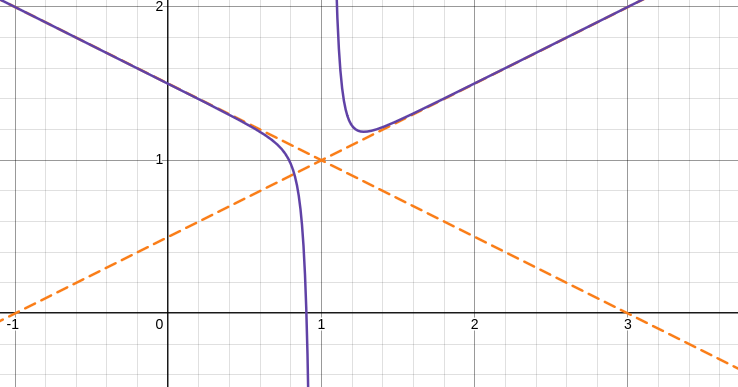 <!-- .element: style="text-align:center" --> What are the orange dashed lines called? What do they mean? <!-- .slide: class="smallertext" data-auto-animate data-auto-animate-restart --> --- ## Infinite limits at infinity Plot of $y = \frac1{1000(x-1)^3} + \frac12\lvert x-1 \rvert + 1$ <!-- .element: style="text-align:center" -->  <!-- .element: style="text-align:center" --> The orange lines are sloped asymptotes. They shows that as $x$ gets very large (positive or negative), $f(x)$ gets very large and positive. <!-- .slide: class="smallertext" data-auto-animate --> --- ## Infinite limits at infinity Plot of $y = \frac1{1000(x-1)^3} + \frac12\lvert x-1 \rvert + 1$ <!-- .element: style="text-align:center" -->  <!-- .element: style="text-align:center" --> We say $\displaystyle \lim\_{x\to\infty} f(x) = \infty$ and $\displaystyle \lim\_{x\to-\infty} f(x) = \infty$. <!-- .slide: class="smallertext" data-auto-animate --> --- ## Infinite limits at infinity Plot of $y = \frac1{1000(x-1)^3} + \frac{-1}2\lvert x-1 \rvert(1+2H(x-1)) + 1$ <!-- .element: style="text-align:center" --> 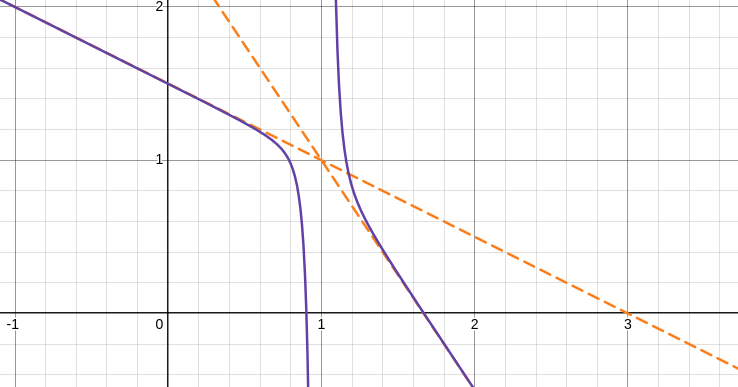 <!-- .element: style="text-align:center" --> We say $\displaystyle \lim\_{x\to\infty} f(x) = -\infty$ and $\displaystyle \lim\_{x\to-\infty} f(x) = \infty$. They need not be the same. <!-- .slide: class="smallertext" data-auto-animate --> --- ## Infinite limits at infinity #### Definition Suppose $f:\mathbb R\to\mathbb R$ and $\ell\in\mathbb R$. <div style="display:flex;flex-direction:row;width:100%"> <div style="flex:0 0 auto;margin-right:1vw"> We say $\displaystyle \lim\_{x\to \infty} f(x) = \infty$ if… </div> <div style="flex:1;margin-left:1vw"> </div> </div> <div style="display:flex;flex-direction:row;width:100%"> <div style="flex:0 0 auto;margin-right:1vw"> We say $\displaystyle \lim\_{x\to \infty} f(x) = -\infty$ if… </div> <div style="flex:1;margin-left:1vw"> </div> </div> #### Exercise Complete the definitions from: <div style="display:flex;flex-direction:row;width:100%"> <div style="flex:0.5;margin-right:1vw;display:flex;justify-content:center;align-items:center;"> <span style="color:var(--uswds-red-cool-20)">$\forall\\, \varepsilon \gt 0$</span><br> <span style="color:var(--uswds-red-cool-20)">$\forall\\, M \gt 0$</span> <!-- .element: style="text-align:center" --> </div> <div style="flex:0.5;margin-left:1vw;margin-right:1vw;display:flex;justify-content:center;align-items:center;"> <span style="color:var(--uswds-indigo-20)">$\exists\\, \delta \gt 0$</span><br> <span style="color:var(--uswds-indigo-20)">$\exists\\, R \gt 0$</span> <!-- .element: style="text-align:center" --> </div> <div style="flex:0;margin-left:1vw;margin-right:1vw;display:flex;justify-content:center;align-items:center;"> such that <!-- .element: style="text-align:center" --> </div> <div style="flex:1;margin-left:1vw;margin-right:1vw;display:flex;justify-content:center;align-items:center;"> <span style="color:var(--uswds-green-cool-20)">$0 \lt \lvert x-a \rvert \lt \delta$</span><br> <span style="color:var(--uswds-green-cool-20)">$0 \lt x-a \lt \delta$</span><br> <span style="color:var(--uswds-green-cool-20)">$0 \lt a-x \lt \delta$</span><br> <span style="color:var(--uswds-green-cool-20)">$x \gt R$</span><br> <span style="color:var(--uswds-green-cool-20)">$x \lt -R$</span> <!-- .element: style="text-align:center" --> </div> <div style="flex:0;margin-left:1vw;margin-right:1vw;display:flex;justify-content:center;align-items:center;"> $\implies$ <!-- .element: style="text-align:center" --> </div> <div style="flex:1;margin-left:1vw;display:flex;justify-content:center;align-items:center;"> <span style="color:var(--uswds-gold-20)">$\lvert f(x)-\ell \rvert \lt \varepsilon$</span><br> <span style="color:var(--uswds-gold-20)">$f(x) \gt M$</span><br> <span style="color:var(--uswds-gold-20)">$f(x) \lt -M$</span> <!-- .element: style="text-align:center" --> </div> </div> <!-- .slide: class="smallertext" data-auto-animate --> --- ## Infinite limits at infinity #### Definition Suppose $f:\mathbb R\to\mathbb R$ and $\ell\in\mathbb R$. <div style="display:flex;flex-direction:row;width:100%"> <div style="flex:0 0 auto;margin-right:1vw"> We say $\displaystyle \lim\_{x\to \infty} f(x) = \infty$ if… </div> <div style="flex:1;margin-left:1vw"> <span style="color:var(--uswds-red-cool-20)">$\forall\\, M \gt 0$</span> <span style="color:var(--uswds-indigo-20)">$\exists\\, R \gt 0$</span> such that <span style="color:var(--uswds-green-cool-20)">$x \gt R$</span> $\implies$ <span style="color:var(--uswds-gold-20)">$f(x) \gt M$</span> </div> </div> <div style="display:flex;flex-direction:row;width:100%"> <div style="flex:0 0 auto;margin-right:1vw"> We say $\displaystyle \lim\_{x\to \infty} f(x) = -\infty$ if… </div> <div style="flex:1;margin-left:1vw"> </div> </div> #### Exercise Complete the definitions from: <div style="display:flex;flex-direction:row;width:100%"> <div style="flex:0.5;margin-right:1vw;display:flex;justify-content:center;align-items:center;"> <span style="color:var(--uswds-red-cool-20)">$\forall\\, \varepsilon \gt 0$</span><br> <span style="color:var(--uswds-red-cool-20)">$\forall\\, M \gt 0$</span> <!-- .element: style="text-align:center" --> </div> <div style="flex:0.5;margin-left:1vw;margin-right:1vw;display:flex;justify-content:center;align-items:center;"> <span style="color:var(--uswds-indigo-20)">$\exists\\, \delta \gt 0$</span><br> <span style="color:var(--uswds-indigo-20)">$\exists\\, R \gt 0$</span> <!-- .element: style="text-align:center" --> </div> <div style="flex:0;margin-left:1vw;margin-right:1vw;display:flex;justify-content:center;align-items:center;"> such that <!-- .element: style="text-align:center" --> </div> <div style="flex:1;margin-left:1vw;margin-right:1vw;display:flex;justify-content:center;align-items:center;"> <span style="color:var(--uswds-green-cool-20)">$0 \lt \lvert x-a \rvert \lt \delta$</span><br> <span style="color:var(--uswds-green-cool-20)">$0 \lt x-a \lt \delta$</span><br> <span style="color:var(--uswds-green-cool-20)">$0 \lt a-x \lt \delta$</span><br> <span style="color:var(--uswds-green-cool-20)">$x \gt R$</span><br> <span style="color:var(--uswds-green-cool-20)">$x \lt -R$</span> <!-- .element: style="text-align:center" --> </div> <div style="flex:0;margin-left:1vw;margin-right:1vw;display:flex;justify-content:center;align-items:center;"> $\implies$ <!-- .element: style="text-align:center" --> </div> <div style="flex:1;margin-left:1vw;display:flex;justify-content:center;align-items:center;"> <span style="color:var(--uswds-gold-20)">$\lvert f(x)-\ell \rvert \lt \varepsilon$</span><br> <span style="color:var(--uswds-gold-20)">$f(x) \gt M$</span><br> <span style="color:var(--uswds-gold-20)">$f(x) \lt -M$</span> <!-- .element: style="text-align:center" --> </div> </div> <!-- .slide: class="smallertext" data-auto-animate --> --- ## Infinite limits at infinity #### Definition Suppose $f:\mathbb R\to\mathbb R$ and $\ell\in\mathbb R$. <div style="display:flex;flex-direction:row;width:100%"> <div style="flex:0 0 auto;margin-right:1vw"> We say $\displaystyle \lim\_{x\to \infty} f(x) = \infty$ if… </div> <div style="flex:1;margin-left:1vw"> <span style="color:var(--uswds-red-cool-20)">$\forall\\, M \gt 0$</span> <span style="color:var(--uswds-indigo-20)">$\exists\\, R \gt 0$</span> such that <span style="color:var(--uswds-green-cool-20)">$x \gt R$</span> $\implies$ <span style="color:var(--uswds-gold-20)">$f(x) \gt M$</span> </div> </div> <div style="display:flex;flex-direction:row;width:100%"> <div style="flex:0 0 auto;margin-right:1vw"> We say $\displaystyle \lim\_{x\to \infty} f(x) = -\infty$ if… </div> <div style="flex:1;margin-left:1vw"> <span style="color:var(--uswds-red-cool-20)">$\forall\\, M \gt 0$</span> <span style="color:var(--uswds-indigo-20)">$\exists\\, R \gt 0$</span> such that <span style="color:var(--uswds-green-cool-20)">$x \gt R$</span> $\implies$ <span style="color:var(--uswds-gold-20)">$f(x) \lt -M$</span> </div> </div> <!-- .slide: class="smallertext" data-auto-animate --> --- ## Infinite limits at infinity #### Definition Suppose $f:\mathbb R\to\mathbb R$ and $\ell\in\mathbb R$. <div style="display:flex;flex-direction:row;width:100%"> <div style="flex:0 0 auto;margin-right:1vw"> We say $\displaystyle \lim\_{x\to \infty} f(x) = \infty$ if… </div> <div style="flex:1;margin-left:1vw"> <span style="color:var(--uswds-red-cool-20)">$\forall\\, M \gt 0$</span> <span style="color:var(--uswds-indigo-20)">$\exists\\, R \gt 0$</span> such that <span style="color:var(--uswds-green-cool-20)">$x \gt R$</span> $\implies$ <span style="color:var(--uswds-gold-20)">$f(x) \gt M$</span> </div> </div> <div style="display:flex;flex-direction:row;width:100%"> <div style="flex:0 0 auto;margin-right:1vw"> We say $\displaystyle \lim\_{x\to \infty} f(x) = -\infty$ if… </div> <div style="flex:1;margin-left:1vw"> <span style="color:var(--uswds-red-cool-20)">$\forall\\, M \gt 0$</span> <span style="color:var(--uswds-indigo-20)">$\exists\\, R \gt 0$</span> such that <span style="color:var(--uswds-green-cool-20)">$x \gt R$</span> $\implies$ <span style="color:var(--uswds-gold-20)">$f(x) \lt -M$</span> </div> </div> #### Exercise <div style="display:flex;flex-direction:row;width:100%"> <div style="flex:0 0 auto;margin-right:1vw"> We say $\displaystyle \lim\_{x\to-\infty} f(x) = \infty$ if… </div> <div style="flex:1;margin-left:1vw"> </div> </div> <div style="display:flex;flex-direction:row;width:100%"> <div style="flex:0 0 auto;margin-right:1vw"> We say $\displaystyle \lim\_{x\to-\infty} f(x) = -\infty$ if… </div> <div style="flex:1;margin-left:1vw"> </div> </div> <!-- .slide: class="smallertext" data-auto-animate --> --- ## Infinite limits at infinity #### Definition Suppose $f:\mathbb R\to\mathbb R$ and $\ell\in\mathbb R$. <div style="display:flex;flex-direction:row;width:100%"> <div style="flex:0 0 auto;margin-right:1vw"> We say $\displaystyle \lim\_{x\to \infty} f(x) = \infty$ if… </div> <div style="flex:1;margin-left:1vw"> <span style="color:var(--uswds-red-cool-20)">$\forall\\, M \gt 0$</span> <span style="color:var(--uswds-indigo-20)">$\exists\\, R \gt 0$</span> such that <span style="color:var(--uswds-green-cool-20)">$x \gt R$</span> $\implies$ <span style="color:var(--uswds-gold-20)">$f(x) \gt M$</span> </div> </div> <div style="display:flex;flex-direction:row;width:100%"> <div style="flex:0 0 auto;margin-right:1vw"> We say $\displaystyle \lim\_{x\to \infty} f(x) = -\infty$ if… </div> <div style="flex:1;margin-left:1vw"> <span style="color:var(--uswds-red-cool-20)">$\forall\\, M \gt 0$</span> <span style="color:var(--uswds-indigo-20)">$\exists\\, R \gt 0$</span> such that <span style="color:var(--uswds-green-cool-20)">$x \gt R$</span> $\implies$ <span style="color:var(--uswds-gold-20)">$f(x) \lt -M$</span> </div> </div> <div style="display:flex;flex-direction:row;width:100%"> <div style="flex:0 0 auto;margin-right:1vw"> We say $\displaystyle \lim\_{x\to-\infty} f(x) = \infty$ if… </div> <div style="flex:1;margin-left:1vw"> <span style="color:var(--uswds-red-cool-20)">$\forall\\, M \gt 0$</span> <span style="color:var(--uswds-indigo-20)">$\exists\\, R \gt 0$</span> such that <span style="color:var(--uswds-green-cool-20)">$x \lt -R$</span> $\implies$ <span style="color:var(--uswds-gold-20)">$f(x) \gt M$</span> </div> </div> <div style="display:flex;flex-direction:row;width:100%"> <div style="flex:0 0 auto;margin-right:1vw"> We say $\displaystyle \lim\_{x\to-\infty} f(x) = -\infty$ if… </div> <div style="flex:1;margin-left:1vw"> <span style="color:var(--uswds-red-cool-20)">$\forall\\, M \gt 0$</span> <span style="color:var(--uswds-indigo-20)">$\exists\\, R \gt 0$</span> such that <span style="color:var(--uswds-green-cool-20)">$x \lt -R$</span> $\implies$ <span style="color:var(--uswds-gold-20)">$f(x) \lt -M$</span> </div> </div> <!-- .slide: class="smallertext" data-auto-animate --> --- ## Continuity at a point #### Definition A function $f:I\to\mathbb R$ is *continuous at* $a\in I$ if $\displaystyle \lim\_{x\to a} f(x) = f(a)$. Note: this requires the limit to exist. <!-- .slide: class="smallertext" data-auto-animate data-auto-animate-restart --> --- ## Continuity at a point #### Definition A function $f:I\to\mathbb R$ is *continuous at* $a\in I$ if $\displaystyle \lim\_{x\to a} f(x) = f(a)$. #### Definition A function $f:I\to\mathbb R$ is *left continuous continuous at* $a\in I$ if #### Definition A function $f:I\to\mathbb R$ is *right continuous continuous at* $a\in I$ if <!-- .slide: class="smallertext" data-auto-animate --> --- ## Continuity at a point #### Definition A function $f:I\to\mathbb R$ is *continuous at* $a\in I$ if $\displaystyle \lim\_{x\to a} f(x) = f(a)$. #### Definition A function $f:I\to\mathbb R$ is *left continuous continuous at* $a\in I$ if $\displaystyle \lim\_{x\to a^-} f(x) = f(a)$. #### Definition A function $f:I\to\mathbb R$ is *right continuous continuous at* $a\in I$ if $\displaystyle \lim\_{x\to a^+} f(x) = f(a)$. <!-- .slide: class="smallertext" data-auto-animate --> --- ## Continuity at a point #### Example 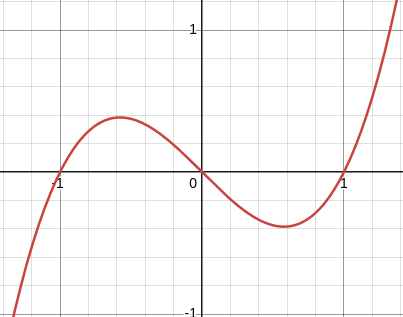 <!-- .element: style="text-align:center" --> <!-- .slide: data-auto-animate --> --- ## Continuity at a point #### Example 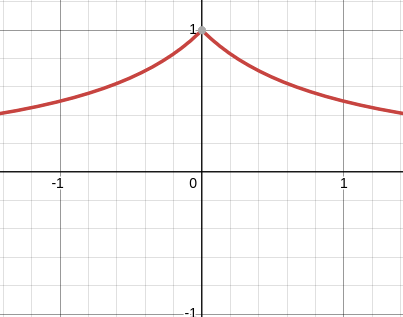 <!-- .element: style="text-align:center" --> <!-- .slide: data-auto-animate --> --- ## Continuity at a point #### Example  <!-- .element: style="text-align:center" --> <!-- .slide: data-auto-animate --> --- ## Continuity at a point #### Example  <!-- .element: style="text-align:center" --> <!-- .slide: data-auto-animate --> --- ## Continuity at a point #### Example  <!-- .element: style="text-align:center" --> <!-- .slide: data-auto-animate --> --- ## Continuity on intervals #### Definition A function $f:I\to\mathbb R$ is *continuous at* $a\in I$ if $\displaystyle \lim\_{x\to a} f(x) = f(a)$. #### Definition A function $f:(a,b)\to\mathbb R$ is *continuous on* $(a,b)$ if $f$ is continuous at $y$ for all $y\in(a,b)$. <!-- .slide: class="smallertext" data-auto-animate data-auto-animate-restart --> --- ## Continuity on intervals #### Definition A function $f:(a,b)\to\mathbb R$ is *continuous on* $(a,b)$ if $f$ is continuous at $y$ for all $y\in(a,b)$. #### Definition $f:[a,b]\to\mathbb R$ is *continuous on* $[a,b]$ if <!-- .slide: class="smallertext" data-auto-animate --> --- ## Continuity on intervals #### Definition A function $f:(a,b)\to\mathbb R$ is *continuous on* $(a,b)$ if $f$ is continuous at $y$ for all $y\in(a,b)$. #### Definition $f:[a,b]\to\mathbb R$ is *continuous on* $[a,b]$ if $f$ is continuous on $(a,b)$ and $f$ is left continuous at $b$ and $f$ is right continuous at $a$. <!-- .slide: class="smallertext" data-auto-animate --> --- ## Continuity on intervals #### Definition A function $f:(a,b)\to\mathbb R$ is *continuous on* $(a,b)$ if $f$ is continuous at $y$ for all $y\in(a,b)$. #### Definition $f:[a,b]\to\mathbb R$ is *continuous on* $[a,b]$ if $f$ is continuous on $(a,b)$ and $f$ is left continuous at $b$ and $f$ is right continuous at $a$. #### Definition $f:(a,b]\to\mathbb R$ is *continuous on* $(a,b]$ if #### Definition $f:[a,b)\to\mathbb R$ is *continuous on* $[a,b)$ if <!-- .slide: class="smallertext" data-auto-animate --> --- ## Continuity on intervals #### Definition A function $f:(a,b)\to\mathbb R$ is *continuous on* $(a,b)$ if $f$ is continuous at $y$ for all $y\in(a,b)$. #### Definition $f:[a,b]\to\mathbb R$ is *continuous on* $[a,b]$ if $f$ is continuous on $(a,b)$ and $f$ is left continuous at $b$ and $f$ is right continuous at $a$. #### Definition $f:(a,b]\to\mathbb R$ is *continuous on* $(a,b]$ if $f$ is continuous on $(a,b)$ and $f$ is left continuous at $b$. #### Definition $f:[a,b)\to\mathbb R$ is *continuous on* $[a,b)$ if $f$ is continuous on $(a,b)$ and $f$ is right continuous at $a$. <!-- .slide: class="smallertext" data-auto-animate --> --- ## Continuity on intervals #### Definition A function $f:(a,b)\to\mathbb R$ is *continuous on* $(a,b)$ if $f$ is continuous at $y$ for all $y\in(a,b)$. #### Definition $f:[a,b]\to\mathbb R$ is *continuous on* $[a,b]$ if $f$ is continuous on $(a,b)$ and $f$ is left continuous at $b$ and $f$ is right continuous at $a$. #### Definition Suppose $X\subseteq\mathbb R$. Then $f:X\to\mathbb R$ is *continuous on* $X$ if $X$ is a union of disconnected intervals and $f$ is continuous on each interval that makes up its domain. By "disconnected intervals", we mean that the intervals cannot join up. <!-- .slide: class="smallertext" data-auto-animate --> --- ## Continuity on intervals #### Example  <!-- .element: style="text-align:center" --> <!-- .slide: data-auto-animate --> --- ## Continuity on intervals #### Example  <!-- .element: style="text-align:center" --> <!-- .slide: data-auto-animate --> --- ## Continuity on intervals #### Example  <!-- .element: style="text-align:center" --> <!-- .slide: data-auto-animate --> --- ## Continuity on intervals #### Example  <!-- .element: style="text-align:center" --> <!-- .slide: data-auto-animate --> --- ## Continuity on intervals #### Example  <!-- .element: style="text-align:center" --> <!-- .slide: data-auto-animate --> --- ## 📷 Classes of continuous functions <div style="display:flex;flex-direction:row;width:100%"> <div style="flex:1;margin-right:1vw"> Constant functions Linear functions Power functions Polynomial functions Rational functions Exponential functions Logarithmic functions Trigonometric functions Inverse trigonometric functions Absolute value function </div> <div style="flex:1;margin-left:1vw"> and, for $f,g$ continuous and $b,c$ constant: $bf+cg$ $f\times g$ $f/g$ except at zeros of $g$ $f \circ g$ provided<br> $\mathrm{range}(g) \subseteq \mathrm{domain}(f)$ </div> </div> <!-- .slide: class="smallertext" data-auto-animate data-auto-animate-restart --> --- ## One reason to care about continuity #### Example Evaluate $\displaystyle \lim\_{x\to3} f(x)$, where $\displaystyle f(x) = \sin\left( \frac{3x-2}{7x^2-\log(5x)} \right) $. <!-- .slide: class="smallertext" data-auto-animate data-auto-animate-restart --> --- ## One reason to care about continuity #### Example Evaluate $\displaystyle \lim\_{x\to3} f(x)$, where $\displaystyle f(x) = \sin\left( \frac{3x-2}{7x^2-\log(5x)} \right) $. #### Solution The function $f$ is continuous at $3$, so $\displaystyle \lim\_{x\to3} f(x)=f(3) = \sin\left( \frac{7}{63-\log(15)} \right)$. <!-- .slide: class="smallertext" data-auto-animate --> --- ## One reason to care about continuity #### Example Evaluate $\displaystyle \lim\_{x\to3} f(x)$, where $\displaystyle f(x) = \sin\left( \frac{3x-2}{7x^2-\log(5x)} \right) $. #### Solution The function $f$ is continuous at $3$, so $\displaystyle \lim\_{x\to3} f(x)=f(3) = \sin\left( \frac{7}{63-\log(15)} \right)$. #### Check this works Carefully check that $f$ is continuous at $3$ using the classes of continuous functions. <!-- .slide: class="smallertext" data-auto-animate --> --- ## Using continuity to evaluate limits #### Example Evaluate $\displaystyle \lim\_{x\to0} f(x)$, $\displaystyle \lim\_{x\to0} g(x)$, $\displaystyle \lim\_{x\to\frac\pi2} q(x)$, where $\displaystyle f(x) = \frac{4x}{x+1}\cos\left( \frac1x \right) $, $\displaystyle g(x) = ([H(x)]^2+5x)^2 $, $\displaystyle q(x) = \sin([\tan(x)]^2) $. <!-- .slide: class="smallertext" data-auto-animate --> --- ## Using continuity to evaluate limits #### Example Evaluate $\displaystyle \lim\_{x\to0} f(x)$, $\displaystyle \lim\_{x\to0} g(x)$, $\displaystyle \lim\_{x\to\frac\pi2} q(x)$, where $\displaystyle f(x) = \frac{4x}{x+1}\cos\left( \frac1x \right) $, $\displaystyle g(x) = ([H(x)]^2+5x)^2 $, $\displaystyle q(x) = \sin([\tan(x)]^2) $. #### Solution We cannot evaluate $\displaystyle \lim\_{x\to0} f(x)$ using continuity, because $0$ is not in the domain of $\frac1x$, so $f$ is not continuous at $0$. But we can distribute limit over the product as $\displaystyle \lim\_{x\to0} f(x) = \left(\lim\_{x\to0} \frac{4}{1+x}\right) \times \left(\lim\_{x\to0} x\cos\left(\frac1x\right)\right)$, then use the sqeeze theorem to evaluate $\lim\_{x\to0} x\cos(\frac1x)=0$, and use continuity to evaluate $\lim\_{x\to0} \frac{4}{1+x}=4$. <!-- .slide: class="smallertext" data-auto-animate --> --- ## Using continuity to evaluate limits #### Example Evaluate $\displaystyle \lim\_{x\to0} f(x)$, $\displaystyle \lim\_{x\to0} g(x)$, $\displaystyle \lim\_{x\to\frac\pi2} q(x)$, where $\displaystyle f(x) = \frac{4x}{x+1}\cos\left( \frac1x \right) $, $\displaystyle g(x) = ([H(x)]^2+5x)^2 $, $\displaystyle q(x) = \sin([\tan(x)]^2) $. #### Solution By definition, $H(0)=0$ but $\lim\_{x\to0^+}H(x)=1$, so $H$ is discontinuous at $0$. However, $[H(x)]^2=1$ for all $x\neq0$, and the limit only sees $x$ close to $0$, not $x=0$. Therefore, for the purpose of evaluating this limit, we can replace $[H(x)]^2$ by the constant function $1$, which is continuous. So $\displaystyle \lim\_{x\to0} g(x) = \lim\_{x\to0} ([H(x)]^2+5x)^2 = \lim\_{x\to0} (1+5x)^2 = 1$, where we have used continuity of the linear function and the square function. <!-- .slide: class="smallertext" data-auto-animate --> --- ## Using continuity to evaluate limits #### Example Evaluate $\displaystyle \lim\_{x\to0} f(x)$, $\displaystyle \lim\_{x\to0} g(x)$, $\displaystyle \lim\_{x\to\frac\pi2} q(x)$, where $\displaystyle f(x) = \frac{4x}{x+1}\cos\left( \frac1x \right) $, $\displaystyle g(x) = ([H(x)]^2+5x)^2 $, $\displaystyle q(x) = \sin([\tan(x)]^2) $. #### Solution Because $\tan(\frac\pi2)$ is undefined, $q$ is discontinuous at $\frac\pi2$. Also the left and right limits of $\tan$ at $\frac\pi2$ do not match. However, $\displaystyle \lim\_{x\to\frac\pi2} [\tan(x)]^2=\infty$ because the left and right limits do match now. But we still can't use continuity, because $\sin(x)$ is not defined at $x=\infty$, and we do not have a meaning for $\sin$ being continuous at $\infty$. <!-- .slide: class="smallertext" data-auto-animate --> --- ## Another reason to care about continuity #### Theorem (Intermediate value theorem) If $f:[a,b]\to\mathbb R$ is continuous and $y$ is strictly between $f(a)$ and $f(b)$, then $\exists t\in(a,b)$ such that $f(t)=y$. <!-- .slide: class="smallertext" data-auto-animate data-auto-animate-restart --> --- ## Another reason to care about continuity #### Theorem (Intermediate value theorem) If $f:[a,b]\to\mathbb R$ is continuous and $y$ is strictly between $f(a)$ and $f(b)$, then $\exists t\in(a,b)$ such that $f(t)=y$. #### Interpretation If there is a line dividing two points, and you want to draw a curve from one point to the other, then your curve will cross the line at least once. <!-- .slide: class="smallertext" data-auto-animate --> --- ## Another reason to care about continuity #### Theorem (Intermediate value theorem) If $f:[a,b]\to\mathbb R$ is continuous and $y$ is strictly between $f(a)$ and $f(b)$, then $\exists t\in(a,b)$ such that $f(t)=y$. #### Interpretation If there is a line dividing two points, and you want to draw a curve from one point to the other, then your curve will cross the line at least once. #### Corollary Every odd order polynomial has a real root. #### Proof Try it. What happens if you evaluate $f(\pm k)$ for $k \gt 0$ large enough? A sketch might help. <!-- .slide: class="smallertext" data-auto-animate --> --- ## Another reason to care about continuity #### Theorem (Intermediate value theorem) If $f:[a,b]\to\mathbb R$ is continuous and $y$ is strictly between $f(a)$ and $f(b)$, then $\exists t\in(a,b)$ such that $f(t)=y$. #### Corollary Every odd order polynomial has a real root. #### Proof Because $f$ is a polynomial, it is continuous. If we make $k \gt 0$ very large, then only the highest power of $x$ in the polynomial is significant, so $f(-k)\lt0$ and $f(k)\gt0$ or the other way around. In either case, $0$ is strictly between $f(-k)$ and $f(k)$. Therefore, by the intermediate value theorem, there exists some $t\in(-k,k)$ such that $f(t)=0$. <!-- .slide: class="smallertext" data-auto-animate --> --- ## Difference quotient #### Definition Let $I$ be an open interval, $x,a\in I$, with $x\neq a$, and $f:I\to \mathbb R$. Then $\displaystyle \frac{f(x)-f(a)}{x-a}$ is the *difference quotient* of $f$ at $x$ and $a$. [Excel file demonstrating the difference quotient](https://nc.dasmithmaths.com/index.php/s/WprS2HSww9MdHaP) <!-- .slide: class="smallertext" data-auto-animate data-auto-animate-restart --> --- ## Derivative #### Definition Let $I$ be an open interval, $a\in I$, and $f:I\to \mathbb R$. Then $\displaystyle \lim\_{x\to a} \frac{f(x)-f(a)}{x-a}$ is the *derivative* of $f$ at $a$. So the derivative at a point is the limit of the difference quotient as $x\to a$. It is the limit of the slope of the chord between $x$ and $a$ as $x\to a$. It is the slope of the tangent at $a$. <!-- .slide: class="smallertext" data-auto-animate data-auto-animate-restart --> --- ## Derivative #### Definition Let $I$ be an open interval, $a\in I$, and $f:I\to \mathbb R$. Then $\displaystyle \lim\_{x\to a} \frac{f(x)-f(a)}{x-a}$ is the *derivative* of $f$ at $a$. So the derivative at a point is the limit of the difference quotient as $x\to a$. It is the limit of the slope of the chord between $x$ and $a$ as $x\to a$. It is the slope of the tangent at $a$. Note $\displaystyle \lim\_{x\to a} \frac{f(x)-f(a)}{x-a} = \lim\_{h\to 0} \frac{f(a+h)-f(a)}{h}$, using $h=x-a$. <!-- .slide: class="smallertext" data-auto-animate --> --- ## Derivative #### Definition Let $I$ be an open interval, $a\in I$, and $f:I\to \mathbb R$. Then $\displaystyle \lim\_{x\to a} \frac{f(x)-f(a)}{x-a}$ is the *derivative* of $f$ at $a$. Note $\displaystyle \lim\_{x\to a} \frac{f(x)-f(a)}{x-a} = \lim\_{h\to 0} \frac{f(a+h)-f(a)}{h}$, using $h=x-a$. #### Example The derivative of $f(x)=x^3+2$ at $a=4$ is $48$. #### Proof $\displaystyle \lim\_{h\to 0} \frac{f(a+h)-f(a)}{h} = \lim\_{h\to 0} \frac{(4+h)^3+2-4^3-2}{h} = \lim\_{h\to 0} \frac{3\times4^2h+3\times4h^2+h^3}{h} = \lim\_{h\to 0} \left(3\times4^2+3\times4h+h^2\right) = 48$. <!-- .slide: class="smallertext" data-auto-animate --> --- ## Differentiability #### Definition Let $I$ be an open interval, $a\in I$, and $f:I\to \mathbb R$. Then $\displaystyle \lim\_{x\to a} \frac{f(x)-f(a)}{x-a}$ is the *derivative* of $f$ at $a$. #### Definition <!-- .element data-id="skg" --> Let $I$ be an open interval, $a\in I$, and $f:I\to \mathbb R$. <!-- .element data-id="skgf" --> If the derivative of $f$ at $a$ exists, then we say that $f$ is *differentiable* at $a$. If, for all $x\in I$, the derivative of $f$ at $x$ exists, then we say that $f$ is *differentiable* on the interval $I$. <!-- .slide: class="smallertext" data-auto-animate --> --- ## Differentiability #### Earlier example $\displaystyle \lim\_{h\to 0} \frac{f(a+h)-f(a)}{h} = \lim\_{h\to 0} \frac{(4+h)^3+2-4^3-2}{h} = \lim\_{h\to 0} \frac{3\times4^2h+3\times4h^2+h^3}{h} = \lim\_{h\to 0} \left(3\times4^2+3\times4h+h^2\right) = 48$, so the derivative of $f(x)=x^3+2$ at $4$ is $48$. #### Definition <!-- .element data-id="skg" --> Let $I$ be an open interval, $a\in I$, and $f:I\to \mathbb R$. <!-- .element data-id="skgf" --> If the derivative of $f$ at $a$ exists, then we say that $f$ is *differentiable* at $a$. If, for all $x\in I$, the derivative of $f$ at $x$ exists, then we say that $f$ is *differentiable* on the interval $I$. #### Example $f(x)=x^3+2$ is differentiable at $4$. <!-- .slide: class="smallertext" data-auto-animate --> --- ## Differentiability #### Earlier example $\displaystyle \lim\_{h\to 0} \frac{f(a+h)-f(a)}{h} = \lim\_{h\to 0} \frac{(4+h)^3+2-4^3-2}{h} = \lim\_{h\to 0} \frac{3\times4^2h+3\times4h^2+h^3}{h} = \lim\_{h\to 0} \left(3\times4^2+3\times4h+h^2\right) = 48$, so the derivative of $f(x)=x^3+2$ at $4$ is $48$. #### Definition <!-- .element data-id="skg" --> Let $I$ be an open interval, $a\in I$, and $f:I\to \mathbb R$. <!-- .element data-id="skgf" --> If the derivative of $f$ at $a$ exists, then we say that $f$ is *differentiable* at $a$. If, for all $x\in I$, the derivative of $f$ at $x$ exists, then we say that $f$ is *differentiable* on the interval $I$. #### Example $f(x)=x^3+2$ is differentiable on $\mathbb R$. Try leaving $a$ general in the above argument. <!-- .slide: class="smallertext" data-auto-animate --> --- ## Differentiability #### Earlier example $\displaystyle \lim\_{h\to 0} \frac{f(a+h)-f(a)}{h} = \lim\_{h\to 0} \frac{(4+h)^3+2-4^3-2}{h} = \lim\_{h\to 0} \frac{3\times4^2h+3\times4h^2+h^3}{h} = \lim\_{h\to 0} \left(3\times4^2+3\times4h+h^2\right) = 48$, so the derivative of $f(x)=x^3+2$ at $4$ is $48$. #### Earlier example with general $a$ $\displaystyle \lim\_{h\to 0} \frac{f(a+h)-f(a)}{h} = \lim\_{h\to 0} \frac{(a+h)^3+2-a^3-2}{h} = \lim\_{h\to 0} \frac{3\times a^2h+3\times ah^2+h^3}{h} = \lim\_{h\to 0} \left(3\times a^2+3\times ah+h^2\right) = 3a^2$, so the derivative of $f(x)=x^3+2$ at $a$ is $3a^2$. So, for any $a\in\mathbb R$, the function $f(x)=x^3+2$ is differentiable at $a$ with derivative $3a^2$. <!-- .slide: class="smallertext" data-auto-animate --> --- ## Derivative function #### Earlier example $\displaystyle \lim\_{h\to 0} \frac{f(a+h)-f(a)}{h} = \lim\_{h\to 0} \frac{(4+h)^3+2-4^3-2}{h} = \lim\_{h\to 0} \frac{3\times4^2h+3\times4h^2+h^3}{h} = \lim\_{h\to 0} \left(3\times4^2+3\times4h+h^2\right) = 48$, so the derivative of $f(x)=x^3+2$ at $4$ is $48$. #### Earlier example at general point $\displaystyle \lim\_{h\to 0} \frac{f(a+h)-f(a)}{h} = \lim\_{h\to 0} \frac{(a+h)^3+2-a^3-2}{h} = \lim\_{h\to 0} \frac{3\times a^2h+3\times ah^2+h^3}{h} = \lim\_{h\to 0} \left(3\times a^2+3\times ah+h^2\right) = 3a^2$, so the derivative of $f(x)=x^3+2$ at $a$ is $3a^2$. So, for any $a\in\mathbb R$, the function $f(x)=x^3+2$ is differentiable at $a$ with derivative $3a^2$. <!-- .slide: class="smallertext" data-auto-animate --> --- ## Derivative function #### Earlier example at general point $\displaystyle \lim\_{h\to 0} \frac{f(a+h)-f(a)}{h} = \lim\_{h\to 0} \frac{(a+h)^3+2-a^3-2}{h} = \lim\_{h\to 0} \frac{3\times a^2h+3\times ah^2+h^3}{h} = \lim\_{h\to 0} \left(3\times a^2+3\times ah+h^2\right) = 3a^2$, so the derivative of $f(x)=x^3+2$ at $a$ is $3a^2$. So, for any $a\in\mathbb R$, the function $f(x)=x^3+2$ is differentiable at $a$ with derivative $3a^2$. We say *the derivative function* of $f$ is $f^\prime(a) = 3a^2$ or, in more common notation, $f'(x) = 3x^2$. Because $f$ is differentiable on $\mathbb R$, the domain of $f'$ is $\mathbb R$. <!-- .slide: class="smallertext" data-auto-animate --> --- ## Differentiability and continuity #### Theorem If $f$ is differentiable at a point, then $f$ is continuous at that point. So all differentiable functions are continuous functions. <!-- .slide: class="smallertext" data-auto-animate data-auto-animate-restart --> --- ## Differentiability and continuity #### Theorem If $f$ is differentiable at a point, then $f$ is continuous at that point. So all differentiable functions are continuous functions. Is the converse true? In other words, are all continuous functions differentiable? <!-- .slide: class="smallertext" data-auto-animate --> --- ## Differentiability and continuity #### Theorem If $f$ is differentiable at a point, then $f$ is continuous at that point. So all differentiable functions are continuous functions. Is the converse true? In other words, are all continuous functions differentiable? We know the absolute value function is continuous. But is differentiable? [Excel file demonstrating the difference quotient](https://nc.dasmithmaths.com/index.php/s/WprS2HSww9MdHaP) <!-- .slide: class="smallertext" data-auto-animate --> --- ## Differentiability and continuity #### Theorem If $f$ is differentiable at a point, then $f$ is continuous at that point. So all differentiable functions are continuous functions. Is the converse true? In other words, are all continuous functions differentiable? We know the absolute value function is continuous. But is differentiable? [Excel file demonstrating the difference quotient](https://nc.dasmithmaths.com/index.php/s/WprS2HSww9MdHaP) So a function can be continuous on an interval but not differentiable at a point on that interval. See the Weierstrass function for a stronger example, which is continuous on $\mathbb R$, but differentiable nowhere. Take MATH2350 to understand the proof. <!-- .slide: class="smallertext" data-auto-animate --> --- ## Differentiation Differentiation means *finding the derivative* of a function. #### Example When we differentiate $f(x)=x^3+2$ we get $f'(x) = 3x^2$. <!-- .slide: class="smallertext" data-auto-animate data-auto-animate-restart --> --- ## Differentiation Differentiation means *finding the derivative* of a function. #### Example When we differentiate $f(x)=x^3+2$ we get $f'(x) = 3x^2$. The course notes contain theorem~1.9, which makes this easier. Use theorem~1.9 and §1.4.3 to evaluate the derivatives on the worksheets. <!-- .slide: class="smallertext" data-auto-animate data-auto-animate-restart -->