## The squeeze theorem for sequences --- ## Squeeze theorem #### Theorem If $\forall\\,n\in\mathbb N,\\, a_n \leqslant b_n \leqslant c_n$ and $\displaystyle\lim\_{n\to\infty} a_n = \ell = \lim\_{n\to\infty} c_n$, then also $\displaystyle\lim\_{n\to\infty} b_n = \ell$. #### Example 1 For sequences $(a_n)\_{n=1}^\infty$, $(b_n)\_{n=1}^\infty$, $(c_n)\_{n=1}^\infty$ defined by $\displaystyle a_n = 0$, $\displaystyle b_n = \frac1{n^3}$, $\displaystyle c_n = \frac1n$, $\displaystyle a_n\to0$ and $\displaystyle c_n\to0$, so $\displaystyle b_n\to0$ also. 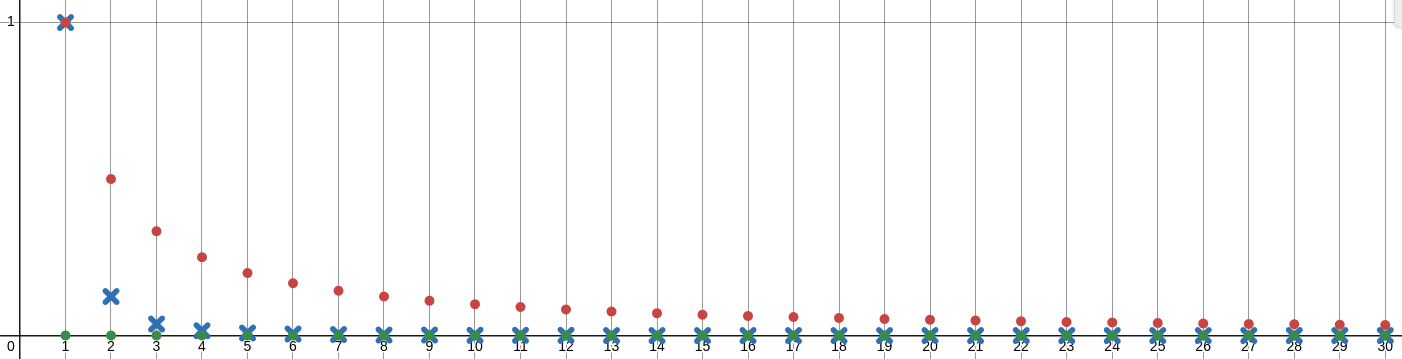 <!-- .slide: class="smallertext" data-auto-animate data-auto-animate-restart --> --- ## Squeeze theorem #### Theorem If $\forall\\,n\in\mathbb N,\\, a_n \leqslant b_n \leqslant c_n$ and $\displaystyle\lim\_{n\to\infty} a_n = \ell = \lim\_{n\to\infty} c_n$, then also $\displaystyle\lim\_{n\to\infty} b_n = \ell$. #### Example 2 For sequences $(a_n)\_{n=1}^\infty$, $(b_n)\_{n=1}^\infty$, $(c_n)\_{n=1}^\infty$ defined by $\displaystyle a_n = \frac{-1}n$, $\displaystyle b_n = \frac{(-1)^n}n$, $\displaystyle c_n = \frac1n$, again $\displaystyle a_n\to0$ and $\displaystyle c_n\to0$, so $\displaystyle b_n\to0$ also. 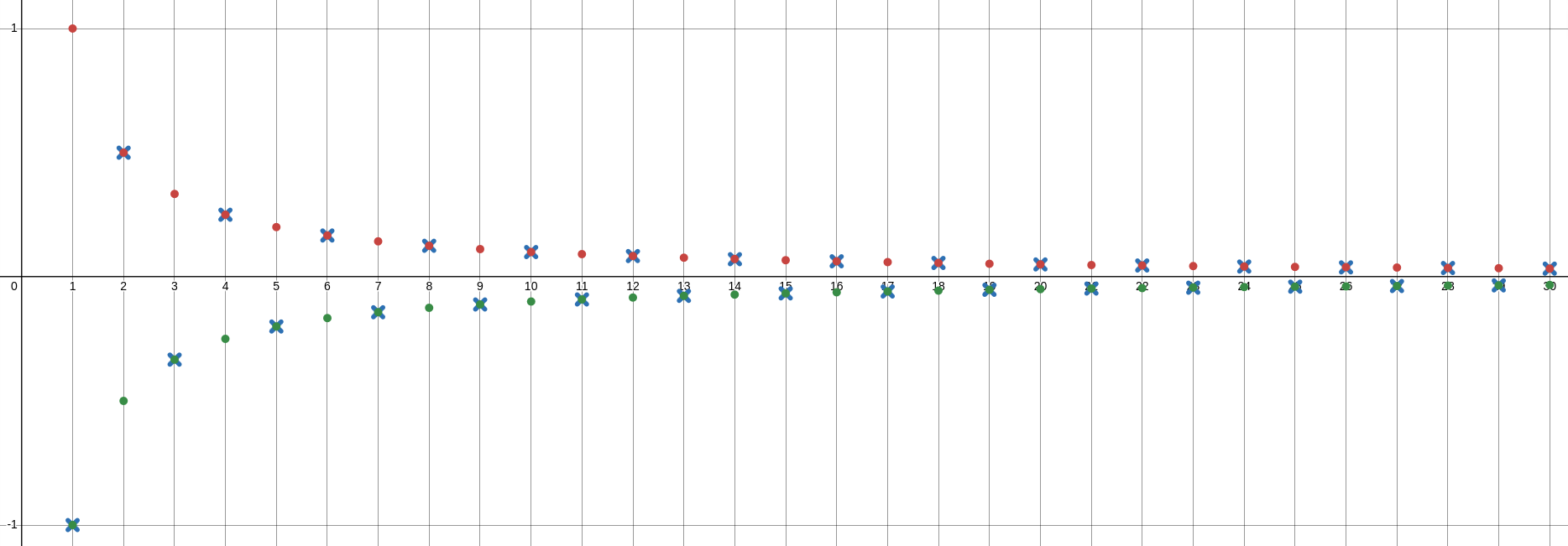 <!-- .slide: class="smallertext" data-auto-animate --> --- ## Squeeze theorem #### Theorem If $\forall\\,n\in\mathbb N,\\, a_n \leqslant b_n \leqslant c_n$ and $\displaystyle\lim\_{n\to\infty} a_n = \ell = \lim\_{n\to\infty} c_n$, then also $\displaystyle\lim\_{n\to\infty} b_n = \ell$. #### Your turn For sequences $(a_n)\_{n=1}^\infty$, $(b_n)\_{n=1}^\infty$, $(c_n)\_{n=1}^\infty$ defined by $\displaystyle a_n = ?$, $\displaystyle b_n = \frac{n^3+20}{n^7+1}$, $\displaystyle c_n = ?$, we need $\displaystyle a_n\to0$ and $\displaystyle c_n\to0$, so that we can argue $\displaystyle b_n\to0$ also. <!-- .slide: class="smallertext" data-auto-animate --> --- ## Squeeze theorem #### Theorem If $\forall\\,n\in\mathbb N,\\, a_n \leqslant b_n \leqslant c_n$ and $\displaystyle\lim\_{n\to\infty} a_n = \ell = \lim\_{n\to\infty} c_n$, then also $\displaystyle\lim\_{n\to\infty} b_n = \ell$. #### Your turn For sequences $(a_n)\_{n=1}^\infty$, $(b_n)\_{n=1}^\infty$, $(c_n)\_{n=1}^\infty$ defined by $\displaystyle a_n = ?$, $\displaystyle b_n = \frac{n^3+20}{n^7+1}$, $\displaystyle c_n = ?$, we need $\displaystyle a_n\to0$ and $\displaystyle c_n\to0$, so that we can argue $\displaystyle b_n\to0$ also. We can use $a_n=0\to0$ and $c_n = \frac{21}n$ because $\frac{n^3+20}{n^7+1} < \frac{21 n^3}{n^7} = \frac{21}{n^4} < \frac{21}n\to0$. <!-- .slide: class="smallertext" data-auto-animate -->